
Answer first
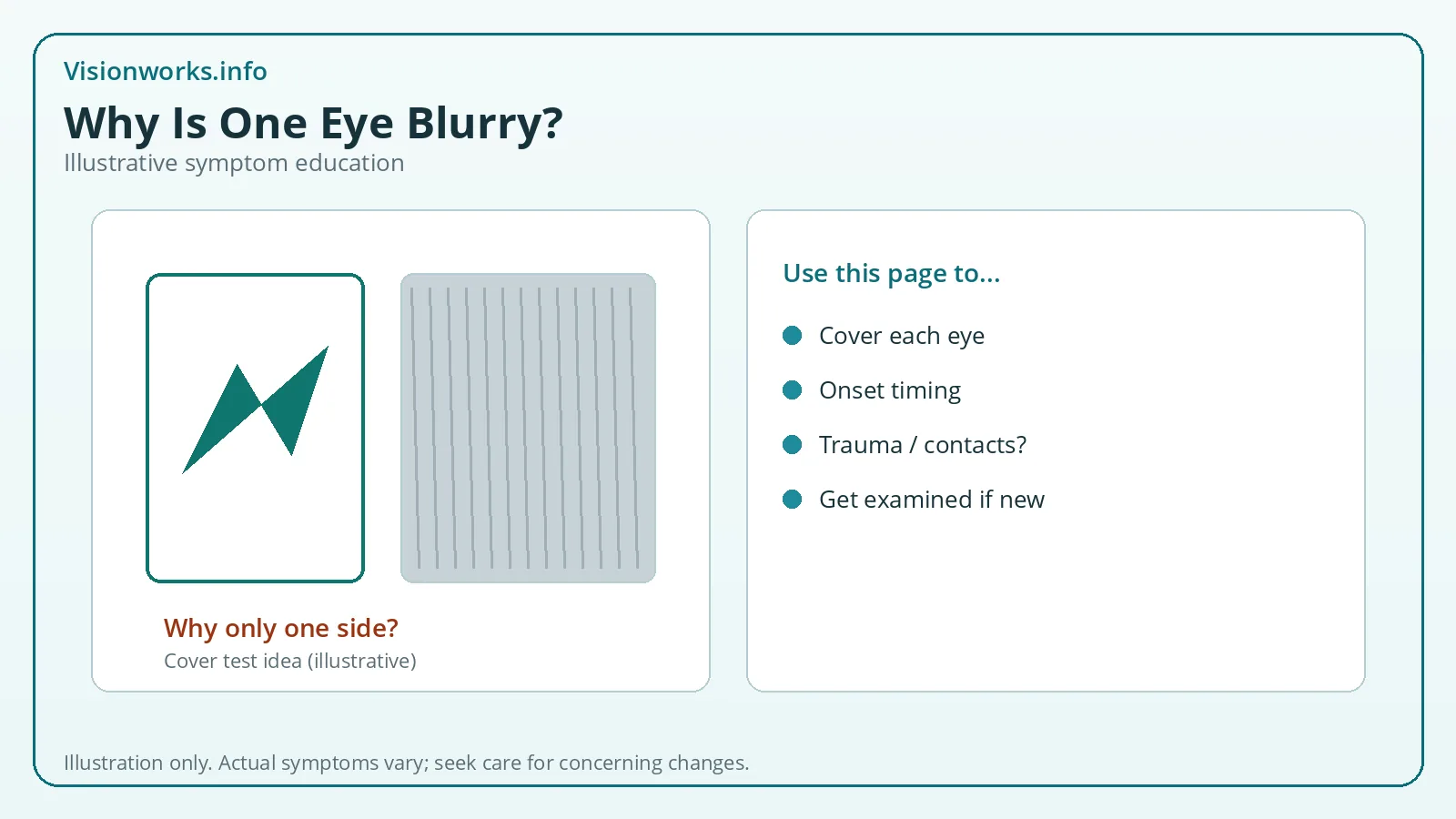
If one eye is blurry and the other is clearer, the problem is often localized to the blurrier eye’s optics or health—or to how the brain is combining the two eyes. Cover-test observation (closing each eye in turn) helps you describe whether the blur is truly monocular.
Common everyday explanations include an outdated or asymmetric glasses/contact prescription, dry eye on one side, a contact lens issue, or mild corneal surface irregularity. Less common—but more urgent—explanations include sudden retinal, vascular, optic-nerve, or inflammatory events. This page cannot diagnose which category applies to you.
Treat new one-eye blur as a signal to organize onset, associated symptoms, and care timing. Stable long-standing asymmetry that you already discussed with an eye clinician is different from a brand-new change noticed today.
Categories of causes (not equally likely)
- Refractive: one eye may need a different sphere, cylinder, or axis than the other; uncorrected astigmatism and myopia often feel monocular when you compare eyes.
- Ocular surface / tear film: dryness, incomplete blink, allergy, or contact-lens overwear can fog one eye first.
- Corneal: abrasion, contact-related hypoxia, infection risk themes, or irregular cornea can reduce that eye’s clarity.
- Lens: early cataract asymmetry or other media changes may make one eye gradually hazier.
- Retinal: macular or peripheral retinal problems can blur one eye; flashes, floaters, distortion, or a curtain raise urgency.
- Optic nerve / neurologic pathways: optic neuritis themes, ischemic optic neuropathy themes, and neurologic events can present with monocular blur—often with other neurologic clues.
- Inflammatory / uveitic themes: pain, light sensitivity, and redness may accompany blur when inflammation is involved.
Listing categories is educational pattern language, not a ranked probability chart for your personal case. Frequency in the general population does not equal likelihood for the person reading this page.
Sudden versus gradual
Gradual one-eye blur over months often tracks refractive change, tear-film habits, or slowly evolving media (such as cataract themes). It still deserves an exam, especially if you drive, work on screens, or notice progressive night glare.
Sudden one-eye blur over minutes to days is a higher-priority pattern. Sudden does not automatically mean “call emergency services for every case,” but it does mean you should not casually wait weeks if the change is clear, persistent, or worsening.
A useful distinction: sudden blur after intense screen work that improves with blinks and rest differs from sudden dense fog, a shadow, distortion of straight lines, or blur with neurologic symptoms. Describe the clock-time of onset when you call a clinic.
Painful versus painless
Painless monocular blur can still be serious (for example, some retinal or optic-nerve presentations). Pain is not required for urgency.
Painful monocular blur with redness, light sensitivity, contact-lens wear, trauma, or a feeling that something is in the eye often points clinicians toward surface, corneal, or inflammatory evaluation sooner.
Headache on the same side as blur, brow ache after near work, or migraine phenomena can coexist with blur without proving a single cause—your clinician sorts the overlap.
Flashes, floaters, redness, and neurologic signs
New flashes of light, a sudden shower of floaters, a gray curtain, or a shadow in one eye are classic vitreoretinal urgency cues taught by organizations such as the American Academy of Ophthalmology. Those patterns deserve same-day ophthalmic triage, not a wait-for-your-annual-exam approach.
Redness with pain and light sensitivity is a different urgency pathway from quiet, white, painless blur. Chemical splash or trauma is an emergency pattern regardless of how “mild” the blur feels at first.
Neurologic companions—face droop, speech difficulty, limb weakness, severe sudden headache, double vision with neurologic signs, or confusion—shift the problem beyond a simple refractive story and toward emergency evaluation.
Questions clinicians may ask
- Which eye is blurrier, and does covering the clear eye make reading worse?
- Did it start suddenly or creep in over weeks?
- Is there pain, redness, discharge, or light sensitivity?
- Any new flashes, floaters, distortion, or a curtain/shadow?
- Do you wear contacts? Any overnight wear, swimming in lenses, or new solutions?
- Any diabetes, hypertension, autoimmune disease, migraine history, or recent illness?
- Any trauma, chemical exposure, or new medications?
- Is distance, near, or both affected? Night driving worse?
Bring a timeline, current glasses/contact details if you have them, and a list of medications. Online acuity tools can help you describe difficulty, but they do not replace clinical refraction or dilated evaluation when indicated.
Routine versus same-day/urgent versus emergency (nuanced)
- Routine / scheduled exam: long-standing mild asymmetry you already know about; gradual mild blur without red flags; screen-related fog that clears with blinking and breaks—still worth an exam if it recurs or affects work/driving.
- Prompt (days, not months): new persistent monocular blur; progressive night glare in one eye; contact-lens discomfort with blur; recurrent headaches tied to one-eye tasks.
- Same-day / urgent ophthalmic care: sudden monocular blur; new flashes with many floaters; curtain/shadow; painful red eye with blur; contact-lens-related possible infection themes; recent eye surgery with new change.
- Emergency services / ER: chemical burn, penetrating trauma, sudden vision loss with neurologic stroke-like signs, severe uncontrolled pain after injury, or inability to get urgent eye care for a clearly dangerous pattern.
Nuance matters: not every sudden blur is a 911 event, and not every gradual blur is safe to ignore. When in doubt about a clear new monocular change, call an eye clinic or urgent ophthalmology pathway and describe the pattern rather than self-triaging from search results.
Related tools and symptom guides
Educational companions on Visionworks.info include the Vision Symptom Explorer, the educational acuity chart, and related guides such as blurry vision in one eye, sudden blurry vision, floaters, and flashes. Condition overviews for myopia, hyperopia, and astigmatism explain refractive language without converting a prescription into a guaranteed acuity score.