
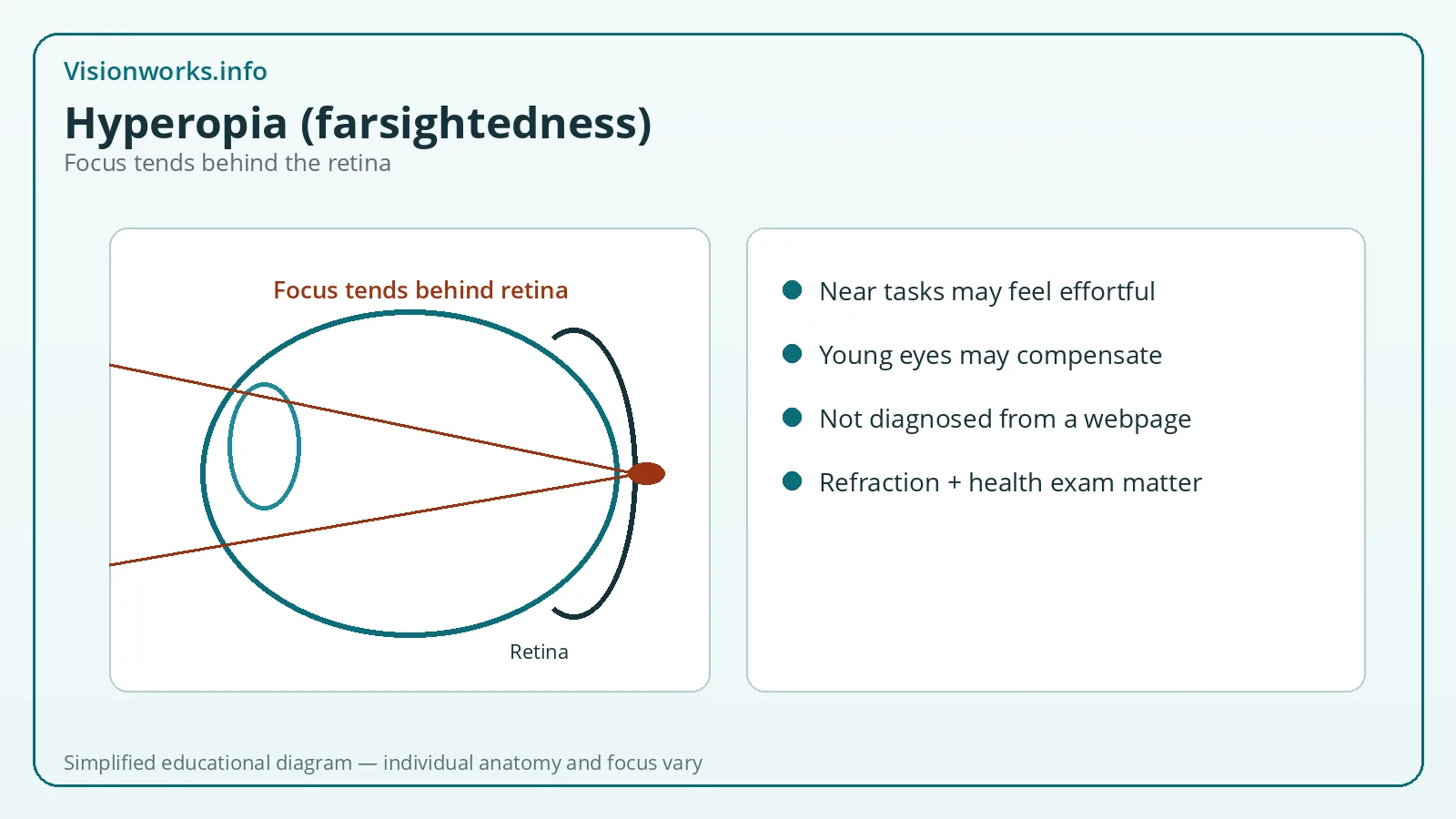
What hyperopia means
Hyperopia is commonly called farsightedness. In teaching models, distance images may focus behind the retina unless the eye accommodates (focuses) to pull the image forward. That extra effort can make near work tiring even when distance letters still look acceptable.
Prescriptions often use plus sphere values (for example, +1.25) when clinicians determine hyperopic correction is needed. Plus numbers are not a DIY shopping code, and they do not map to a fixed acuity score on this site.
Symptoms across ages
Children may show avoidance of near tasks, fatigue, or binocular stress signs rather than clear complaints. Adults may report near blur, brow ache after documents, or intermittent distance softness when tired. Latent hyperopia can be unmasked with clinical techniques—not with a phone app alone.
How exams clarify the picture
Refraction, binocular testing, and eye-health evaluation distinguish hyperopia from presbyopia, dry-eye fog, and other causes of near trouble. Cycloplegic refraction may be used in some pediatric or latent-hyperopia contexts—your clinician decides.
Hyperopia versus presbyopia
Hyperopia is a refractive error that can exist at any age. Presbyopia is age-related decline in focusing amplitude that commonly becomes noticeable in the 40s. They can coexist. Readers bought at a pharmacy do not diagnose which pattern you have.
Correction and everyday life
Glasses or contacts may be prescribed full-time or for near/intermediate tasks depending on findings and visual demands. Progressive or bifocal designs appear later when near adds are needed. Contact-lens wear still requires fitting and hygiene.
When to seek care
Seek an exam for near avoidance in children, persistent near strain, headaches with close work, or new blur. Urgent pathways remain for sudden vision loss, painful red eye, flashes/floaters/curtain, or neurologic signs—not for every plus-power update.
Related resources
Near blur, presbyopia, sphere guide, near vision tool, ADD explainer.Practical depth on hyperopia (1)
Describe your most recent real-world example involving hyperopia rather than a hypothetical worst case.
Separate chronic background issues from the new change that brought you to /conditions/hyperopia/.
For conditions topics like hyperopia, laterality (one eye vs both) changes urgency more than dramatic adjectives alone.
Painful patterns around hyperopia usually need faster pathways than painless gradual annoyance—yet painless sudden loss can still be urgent.
Practical depth on hyperopia (2)
If screens are involved in your hyperopia story, fix blink/break/ergonomics while still booking an exam for persistent blur.
Children’s descriptions of hyperopia may be behavioral (avoidance, squinting) rather than adult symptom words—caregivers should not wait for perfect vocabulary.
Medication lists matter for hyperopia visits because drying agents and other drugs can alter comfort and focusing.
Contact-lens details belong in any hyperopia history: brand/schedule, overnight wear, swimming, and solution habits.
Practical depth on hyperopia (3)
Night driving complaints tied to hyperopia deserve explicit mention because low light unmasks optics and glare problems.
After reading /conditions/hyperopia/, write three questions for your clinician instead of collecting ten overlapping browser tabs.
Visionworks.info will not convert a prescription into acuity on /conditions/hyperopia/; ask the clinic for measured acuity with and without correction.
If you use an educational tool after visiting /conditions/hyperopia/, treat the result as conversation fuel, not a diagnosis code.
Practical depth on hyperopia (4)
Document whether hyperopia improved after blinking, lubricating drops you already use, or removing glasses/contacts—and tell the examiner which.
Sudden companions—flashes, floater showers, curtains, neurologic deficits—override ordinary hyperopia self-help checklists.
Stable long-standing hyperopia still benefits from periodic exams because eye health and refraction can change quietly.
Workplace or school demands related to hyperopia help clinicians prioritize intermediate zones, sports, or classroom distances.
Practical depth on hyperopia (5)
Bring prior paperwork to appointments about hyperopia; photos of glasses engravings are better than reconstructed memories.
Avoid escalating OTC readers or buying random blue filters as the only response to hyperopia without an examination plan.
If cost is a barrier, prioritize urgent red-flag patterns connected to hyperopia and ask clinics about urgent walk-in eye pathways.
Re-read the answer-first section of /conditions/hyperopia/ after your visit to see which educational category matched clinical findings—and which did not.
Practical depth on hyperopia (6)
Topic summary anchor for /conditions/hyperopia/: Hyperopia (farsightedness) is a refractive error where the eye must exert extra focusing effort for clarity, especially at near. Keep that sentence in mind when symptoms feel chaotic.
Internal links on /conditions/hyperopia/ exist to map symptom↔condition↔tool relationships; follow two of them that match your situation instead of opening everything.
Language tip for hyperopia: say “soft,” “filmy,” “distorted,” “double,” or “shadowed” because those words triage differently than the generic word “blurry.”
Timing tip for hyperopia: minutes-to-hours onset is not the same as months-long drift, even when both are annoying.