
Answer first
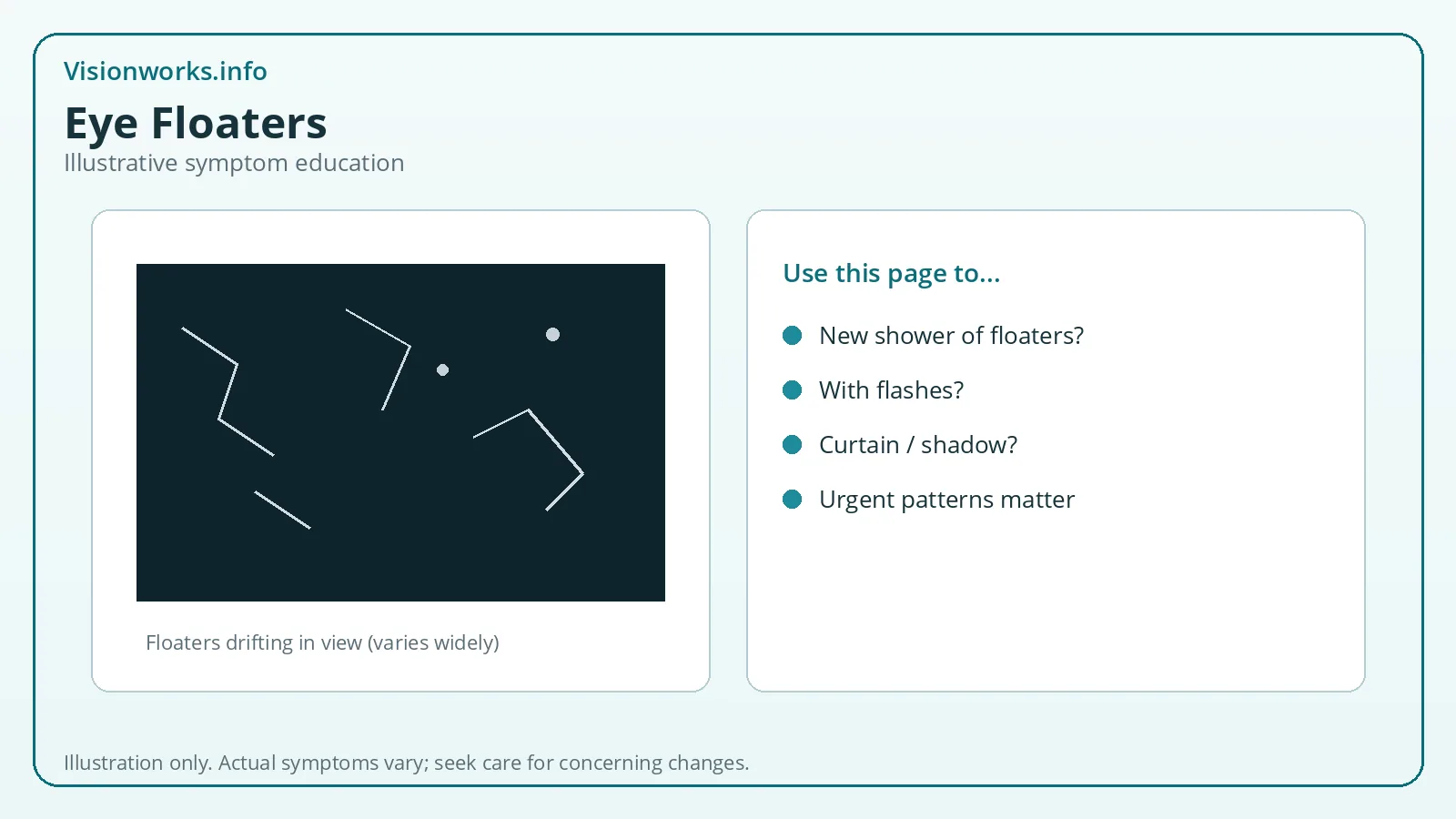
Floaters look like dots, threads, cobwebs, or blobs that drift when you move your eyes. They are often tiny vitreous condensations casting shadows on the retina.
Many adults notice a few stable floaters in bright sky or against a white wall. A sudden increase—especially with flashes of light or a shadow/curtain—is a different pattern that the American Academy of Ophthalmology treats as a reason for prompt dilated examination to look for retinal tear or detachment.
Categories of associations (not equal likelihood)
Age-related vitreous changes and posterior vitreous detachment themes are common educational associations. Nearsightedness, prior inflammation, prior injury/surgery, and bleeding risk discussions also appear in floater education. Retinal tears/detachments are less common than ordinary floaters but drive urgency teaching when new clusters appear with flashes or field loss.
Sudden versus gradual
A single familiar speck you have had for years is usually a scheduled-visit topic if it is stable. A sudden “swarm,” “smoke,” or “pepper” of new floaters—same day or overnight—is an urgent pattern even if vision still seems mostly clear.
Painful versus painless
Classic vitreous floaters are often painless. Painful red eye with floaters is not the typical PVD story and needs its own urgent evaluation pathway.
Flashes, curtain, redness, neurologic signs
Flashes (photopsias) with new floaters raise concern for vitreous traction on the retina. A curtain, shadow, or rising/descending gray area is a detachment warning pattern. Neurologic stroke-like signs with visual change are an emergency pathway distinct from ordinary floaters.
Questions clinicians may ask
Which eye? When did new floaters start? Any flashes? Any curtain/shadow? Any trauma? Are you highly myopic? Any prior retinal problems? Bring a clear timeline—hours matter more than poetry.
Routine vs same-day/urgent vs emergency
- Routine: few long-stable floaters without new flashes or field loss.
- Same-day/urgent ophthalmology: sudden many new floaters; flashes with new floaters; any curtain/shadow; post-trauma floaters.
- Emergency: sudden vision loss with neurologic deficits; trauma with penetrating injury; inability to access urgent eye care for a curtain pattern.
Nuance: not every floater is a detachment, and not every floater can wait for next year’s exam. When the pattern is new and dramatic, err toward same-day dilated care.
Related tools and pages
Flashes, sudden blur, symptom explorer, myopia (higher myopia is often discussed in floater/retina education).Practical depth on floaters (1)
Describe your most recent real-world example involving floaters rather than a hypothetical worst case.
Separate chronic background issues from the new change that brought you to /symptoms/floaters/.
For symptoms topics like floaters, laterality (one eye vs both) changes urgency more than dramatic adjectives alone.
Painful patterns around floaters usually need faster pathways than painless gradual annoyance—yet painless sudden loss can still be urgent.
Practical depth on floaters (2)
If screens are involved in your floaters story, fix blink/break/ergonomics while still booking an exam for persistent blur.
Children’s descriptions of floaters may be behavioral (avoidance, squinting) rather than adult symptom words—caregivers should not wait for perfect vocabulary.
Medication lists matter for floaters visits because drying agents and other drugs can alter comfort and focusing.
Contact-lens details belong in any floaters history: brand/schedule, overnight wear, swimming, and solution habits.
Practical depth on floaters (3)
Night driving complaints tied to floaters deserve explicit mention because low light unmasks optics and glare problems.
After reading /symptoms/floaters/, write three questions for your clinician instead of collecting ten overlapping browser tabs.
Visionworks.info will not convert a prescription into acuity on /symptoms/floaters/; ask the clinic for measured acuity with and without correction.
If you use an educational tool after visiting /symptoms/floaters/, treat the result as conversation fuel, not a diagnosis code.
Practical depth on floaters (4)
Document whether floaters improved after blinking, lubricating drops you already use, or removing glasses/contacts—and tell the examiner which.
Sudden companions—flashes, floater showers, curtains, neurologic deficits—override ordinary floaters self-help checklists.
Stable long-standing floaters still benefits from periodic exams because eye health and refraction can change quietly.
Workplace or school demands related to floaters help clinicians prioritize intermediate zones, sports, or classroom distances.
Practical depth on floaters (5)
Bring prior paperwork to appointments about floaters; photos of glasses engravings are better than reconstructed memories.
Avoid escalating OTC readers or buying random blue filters as the only response to floaters without an examination plan.
If cost is a barrier, prioritize urgent red-flag patterns connected to floaters and ask clinics about urgent walk-in eye pathways.
Re-read the answer-first section of /symptoms/floaters/ after your visit to see which educational category matched clinical findings—and which did not.