
What myopia means
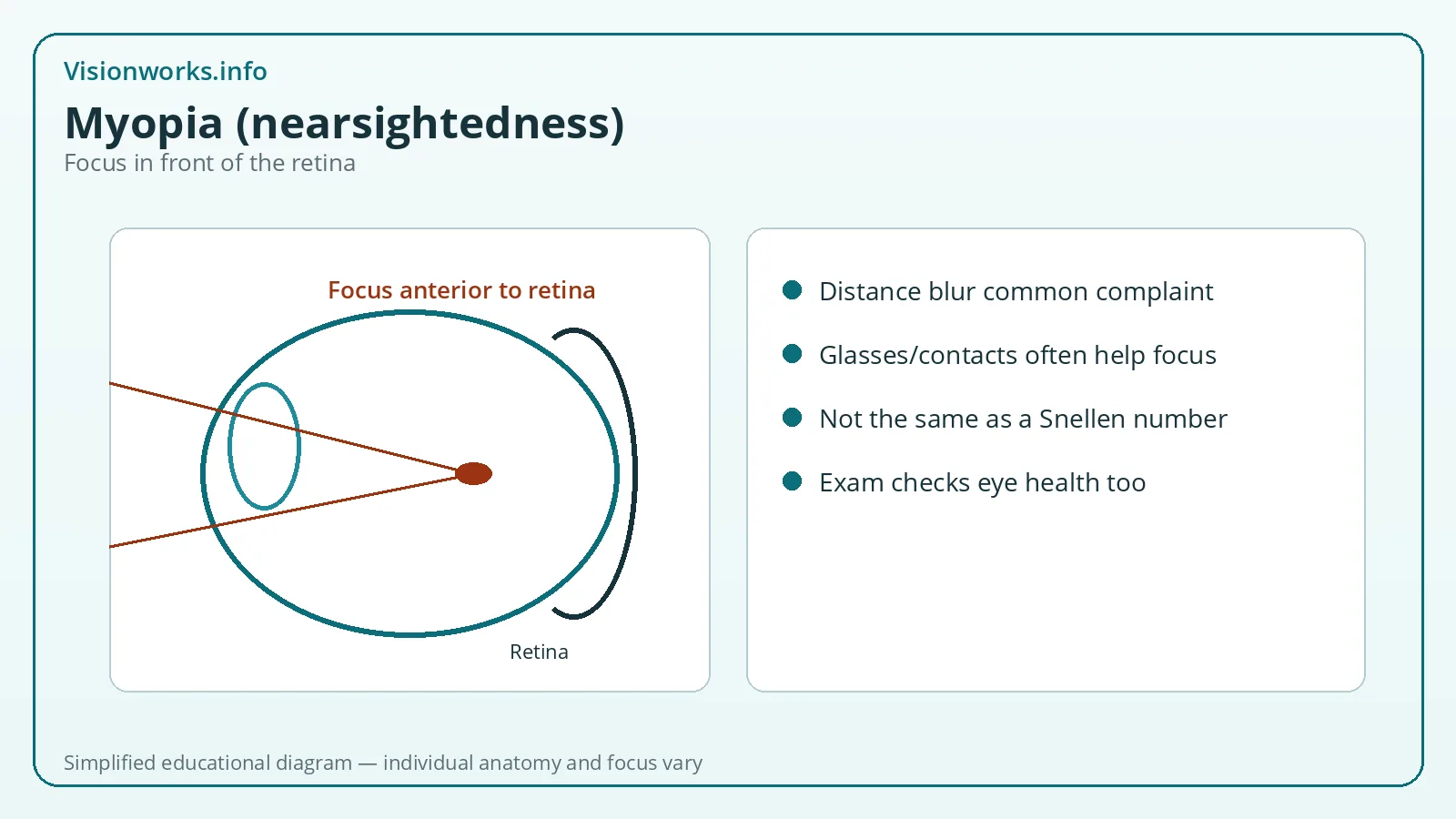
Myopia is commonly called nearsightedness because nearer objects are often clearer than distant ones when the optical focus falls short of the retina for distance viewing. National Eye Institute education describes myopia as a refractive error—an optics mismatch—rather than a single “eye disease label” for every person who needs minus lenses.
On a glasses prescription, myopia-related distance correction is written with a minus sphere (for example, −1.50 or −3.00). Those numbers describe lens power a clinician selected after examination. They are not moral grades, and this site will not convert a sphere into a guaranteed Snellen fraction such as 20/40 or 20/200.
How the optics go soft at distance
In simplified teaching models, either the eye’s focusing power is relatively strong for its length, or the eye is relatively long for its focusing power, so distant images blur on the retina. Real eyes also include corneal shape, lens contributions, and higher-order factors—clinical refraction measures the usable correction, not a classroom diagram.
Astigmatism can coexist with myopia, adding cylinder and axis lines on the same prescription. Hyperopia is a different refractive direction (plus sphere teaching). Presbyopia is an age-related near-focusing decline that can appear later even in people who already wear distance glasses.
Symptoms people notice
Classic educational symptoms include squinting at road signs, difficulty seeing classroom boards, sitting closer to screens or stages, and evening distance blur. Headaches and eye strain can appear when people constantly push focus, but headaches alone do not prove myopia.
Children may not complain in adult language—they may lose interest in distant details, copy from neighbors, or prefer near play. That is why school screenings and comprehensive exams matter; a website quiz cannot replace them.
What a comprehensive exam looks for
Clinicians measure visual acuity, refine refraction (often with fogging and binocular balance techniques), and evaluate eye health. Depending on age and findings, they may discuss dilation, binocular vision, and ocular health risks associated with higher myopia in clinical literature.
Bring prior glasses, contact-lens boxes, and a symptom timeline. If one eye is much blurrier, say so—asymmetric myopia is common and still needs careful monocular assessment.
Children, teens, and progression conversations
Myopia often begins or progresses in school years. AOA and NEI educational materials encourage regular exams rather than waiting for a failed classroom year. Outdoor time and visual habits appear in public-health conversations; they are not guaranteed prevention formulas and do not replace prescribed care.
If a clinician discusses myopia-management options, those are individualized medical/optometric decisions. Visionworks.info does not prescribe ortho-k, atropine, or specialty lenses, and does not rank commercial products.
Glasses, contacts, and everyday function
Spectacles and contact lenses are common optical tools to move the distance image onto the retina. Lens index, thickness, and coatings affect comfort and cosmetics but do not change the underlying refractive diagnosis. Contact lenses require fitting and hygiene education; sleeping in lenses not prescribed for extended wear raises risk discussions.
Some people ask whether myopia is “bad.” Severity language in clinics is about optical need and eye-health monitoring, not character. A −2.00 example is moderate in many informal conversations; a −6.00 example is higher—yet neither number alone tells your retinal health story without examination.
Myths to retire
- Myth: Sitting too close to a TV permanently “gives” a specific prescription number.
Education: Habits and progression associations are researched topics; they do not let you calculate your sphere at home. - Myth: Minus lenses make eyes weaker forever.
Education: Proper correction helps you see; progression is a clinical monitoring issue, not a reason to avoid needed clarity. - Myth: A sphere maps to an exact acuity.
Education: Acuity depends on more than sphere—cylinder, adaptation, disease, and testing conditions matter.
When to seek care
Schedule exams for new distance blur, failed screenings, frequent squinting, or overdue care. Seek urgent care for sudden monocular vision loss, flashes with many new floaters, or a curtain/shadow—patterns that are about retinal urgency, not about “needing a stronger minus.” Routine myopia updates are not 911 events; sudden dangerous companions are.
Related Visionworks.info resources
Symptom guides: distance blur, blur hub. Prescription education: sphere, example pages such as −2.00. Tools: vision simulator, prescription decoder, diopter calculator. Related conditions: astigmatism, hyperopia.
Living with distance correction
People with myopia often keep a “distance pair” mental model: glasses on for driving and lectures, sometimes off for very near crafts if their uncorrected near vision is usable. That habit is individual. Do not copy someone else’s on/off routine without understanding your own refraction and eye-health advice.
Contact-lens wearers should treat redness, pain, or sudden fog as reasons to remove lenses and seek care—not as a nudge to “push through” an important meeting. Hygiene shortcuts are a common preventable risk theme in contact education.
If your prescription changes frequently, ask whether the change is refractive progression, measurement variability, or another ocular factor. Bring old pairs when possible so the clinician can compare what you actually wear with what the chart suggests.