
Answer first
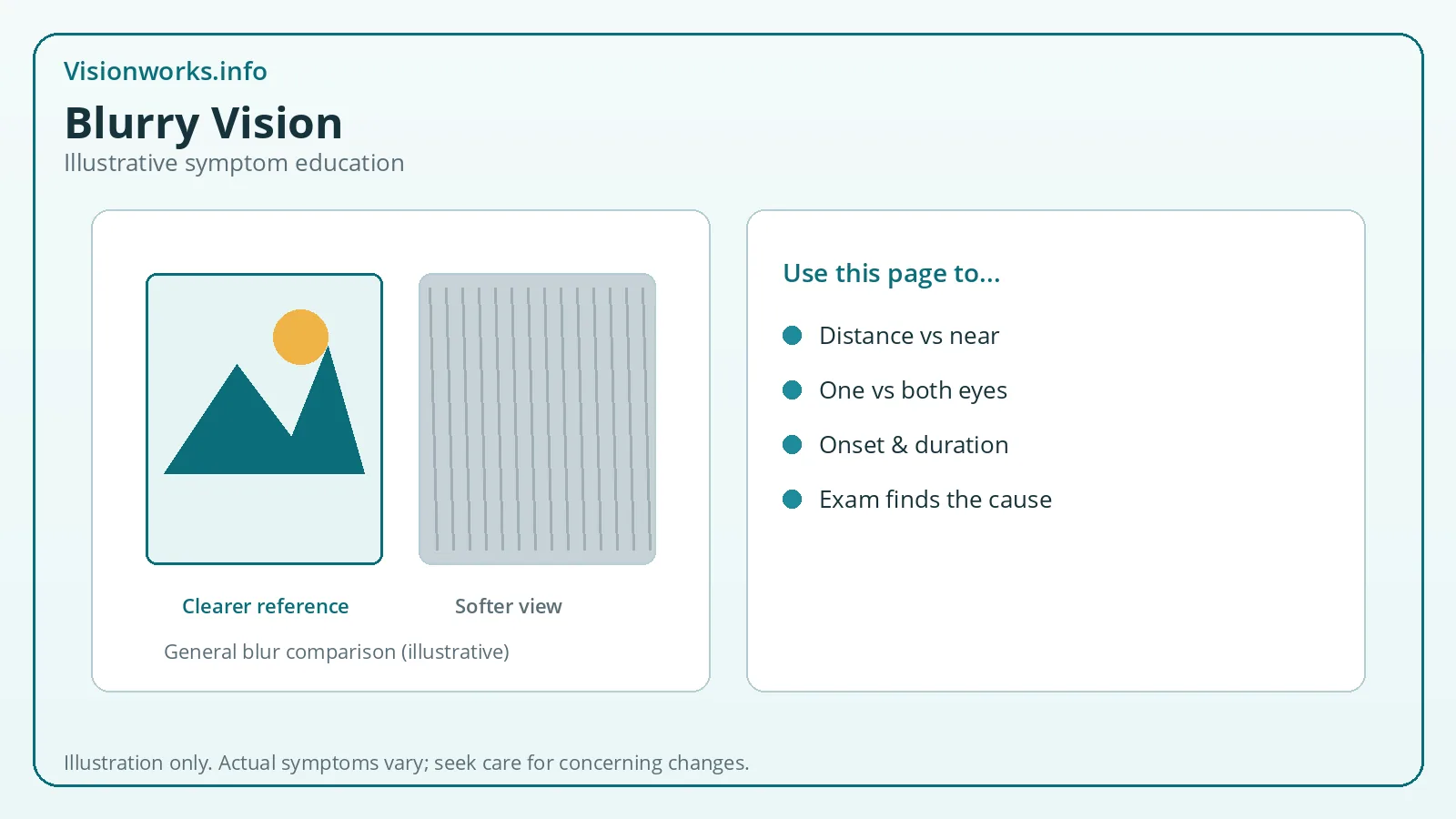
“Blurry vision” means detail looks softer, less sharp, or harder to resolve than you expect for the task. It can affect distance, near, or both; one eye or both; constantly or only after certain tasks.
Many people first notice blur when road signs, phone text, or classroom boards become harder. Others notice intermittent fog that clears with blinking. Those everyday stories can share a word—“blur”—while pointing to different clinical pathways.
Visionworks.info uses blur pages to teach pattern language and care timing. We do not assign a disease label from a website form, and we do not convert a glasses prescription into a guaranteed Snellen score.
Categories of causes (as relevant, not equally likely)
- Refractive errors: myopia, hyperopia, astigmatism, and aging near-focus change (presbyopia) are common educational associations for soft focus.
- Ocular surface: unstable tears create fluctuating blur that often improves briefly after a blink.
- Corneal: surface irregularity, contact-lens issues, or injury can scatter light.
- Lens / media: cataract themes and other media haze can gradually reduce contrast and clarity.
- Retinal: macular or peripheral retinal disease may blur or distort; flashes/floaters/curtain change urgency.
- Optic nerve / neurologic: pathway problems may reduce acuity or field with or without pain.
- Inflammatory: internal or surface inflammation can pair blur with light sensitivity or redness.
National Eye Institute and MedlinePlus educational materials on refractive errors are useful background for the optics category, while AAO patient pages help frame flashes/floaters urgency when those companions appear.
Sudden versus gradual
Gradual blur over months is commonly discussed alongside prescription change, dry-eye habits, or slowly evolving media. It still warrants an eye exam when tasks suffer or the change is new to you.
Sudden blur is a priority signal. Priority does not mean every sudden episode is a stroke or detachment—but it does mean you should describe the onset clearly and ask for timely triage rather than assuming “it will clear by Monday.”
Task-linked blur that appears after long near work and eases with breaks is a different educational story from a fixed fog that appears in one eye while you are watching TV.
Painful versus painless
Painless blur is common with refractive error and some retinal or optic conditions. Lack of pain never proves safety.
Painful blur—especially with redness, photophobia, contact-lens wear, or trauma—usually moves clinicians toward surface/corneal/inflammatory evaluation sooner.
Associated signs that change the story
Add flashes, floaters, curtain/shadow, distortion of straight lines, double vision, neurologic deficits, severe headache, nausea with eye pain, or chemical/trauma history to your description. Those companions change urgency more than the word “blur” alone.
Questions clinicians may ask
Expect questions about which eye, distance vs near, onset clock-time, contact lenses, medical history (including diabetes and hypertension), medications, migraine, and whether letters look distorted rather than merely soft. Bring prior prescriptions if available.
Routine versus same-day/urgent versus emergency
- Routine: mild, stable, long-familiar blur; scheduled refraction updates; screen fatigue that resets with rest—still examine if overdue.
- Prompt: new persistent blur; worsening night driving; headaches with visual tasks; contact discomfort with haze.
- Same-day/urgent: sudden blur; monocular curtain/flashes/floater shower; painful red eye; post-operative change.
- Emergency: chemical injury, penetrating trauma, stroke-like neurologic signs with vision change, or sudden severe loss when urgent eye care is inaccessible.
Related tools and deeper symptom pages
Start with the symptom explorer for structured educational pathways. Narrower guides cover one eye, both eyes, distance, near, sudden onset, and screen-related blur. Condition pages explain myopia, hyperopia, astigmatism, and presbyopia without diagnosing you.
Practical depth on blurry vision (1)
Describe your most recent real-world example involving blurry vision rather than a hypothetical worst case.
Separate chronic background issues from the new change that brought you to /symptoms/blurry-vision/.
For symptoms topics like blurry vision, laterality (one eye vs both) changes urgency more than dramatic adjectives alone.
Painful patterns around blurry vision usually need faster pathways than painless gradual annoyance—yet painless sudden loss can still be urgent.
Practical depth on blurry vision (2)
If screens are involved in your blurry vision story, fix blink/break/ergonomics while still booking an exam for persistent blur.
Children’s descriptions of blurry vision may be behavioral (avoidance, squinting) rather than adult symptom words—caregivers should not wait for perfect vocabulary.
Medication lists matter for blurry vision visits because drying agents and other drugs can alter comfort and focusing.
Contact-lens details belong in any blurry vision history: brand/schedule, overnight wear, swimming, and solution habits.
Practical depth on blurry vision (3)
Night driving complaints tied to blurry vision deserve explicit mention because low light unmasks optics and glare problems.
After reading /symptoms/blurry-vision/, write three questions for your clinician instead of collecting ten overlapping browser tabs.
Visionworks.info will not convert a prescription into acuity on /symptoms/blurry-vision/; ask the clinic for measured acuity with and without correction.
If you use an educational tool after visiting /symptoms/blurry-vision/, treat the result as conversation fuel, not a diagnosis code.