
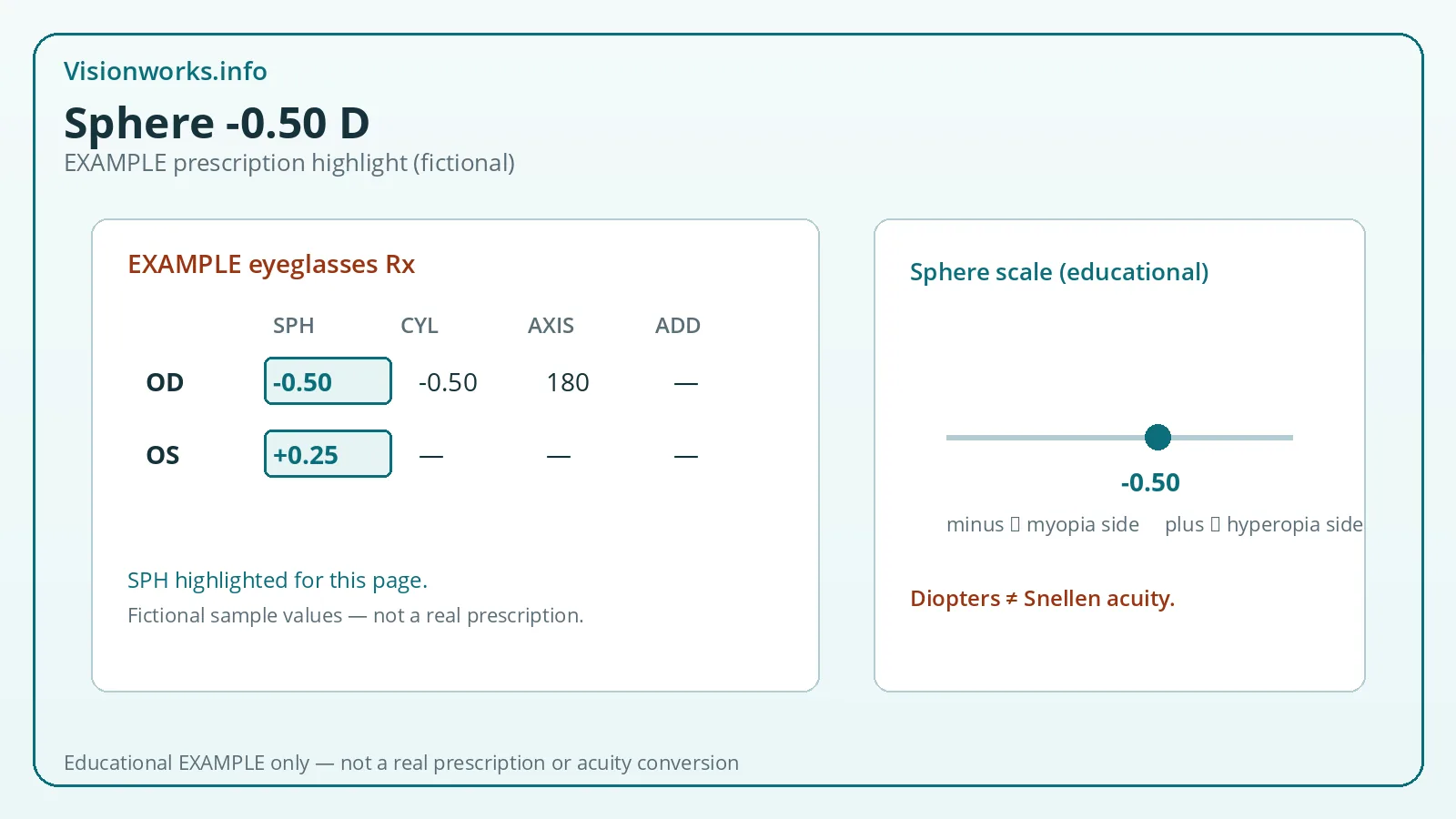
What -0.50 D sphere means
A sphere value of -0.50 diopters is very mild minus spherical power on an educational scale. Sphere (SPH) is the rotationally symmetric focusing power written for that eye on a glasses prescription. (Context page: /prescription/sphere/-0-50/).
This page teaches notation. It does not declare your vision “good” or “bad,” and it does not identify a Snellen acuity such as 20/20 or 20/40 from -0.50 alone.
Think of −0.50 as a light optical nudge when prescribed—not a destiny label.
People sometimes skip exams because −0.50 “sounds tiny,” yet symptoms, binocular comfort, and eye health still deserve professional review.
Why “bad eyesight” framing misleads
“−0.50 means my eyes are already bad.” Mild sphere values are common teaching examples, not moral failures. (Context page: /prescription/sphere/-0-50/).
A written -0.50 value describes optical power for fabricating lenses when prescribed—not an ethics score, intelligence score, or complete eye-health certificate.
Two people who both see -0.50 on paperwork can experience different comfort based on cylinder, binocular vision, tear film, lighting, and retinal health.
Cylinder, axis, add, and other independent fields
Cylinder/axis can still matter even when sphere is tiny; a small CYL with the wrong axis can bother a detail-oriented viewer more than −0.50 sphere alone. (Context page: /prescription/sphere/-0-50/).
Cylinder + axis correct astigmatism; ADD supports near focus in multifocals; prism/base address alignment; PD supports centration. None of those fields can be invented from -0.50 alone.
-0.50 sphere with plano cylinder is a different lens than -0.50 with significant CYL—even when internet threads obsess over sphere only.
No prescription-to-acuity conversion
Uncorrected refractive error related to a minus sphere like -0.50 can blur tasks, but acuity depends on more than SPH: astigmatism, eye health, pupil size, chart contrast, and monocular versus binocular testing. (Context page: /prescription/sphere/-0-50/).
Visionworks.info will not map -0.50 D to an exact 20/xx line. Ask for measured acuity at your exam if you need that number.
Autorefractors, retinoscopes, and subjective refraction contribute differently to a final -0.50-class sphere; blogs that skip that complexity are guessing.
Everyday task context (educational, not diagnostic)
Some people notice soft distance edges on night street signs while daytime near work still feels easy; others notice almost nothing until a screening flags a line change. (Context page: /prescription/sphere/-0-50/).
Task stories help learners imagine what -0.50 magnitude conversations sound like; they are not diagnostic criteria and not a substitute for refraction.
If driving ability is your concern around a -0.50 prescription, clinicians measure acuity/fields as indicated and you follow state rules—sphere alone is not legal advice.
Glasses, contacts, and fabrication notes
Lens thickness rarely dominates conversation at this magnitude compared with higher powers, but coatings, fit, and accurate PD still influence comfort. (Context page: /prescription/sphere/-0-50/).
A valid glasses prescription showing -0.50 is not automatically a valid contact lens prescription.
U.S. prescription-release education concerns copies of Rxs; it is not a DIY refraction method [-0-50].
How clinicians arrive at sphere
Refraction blends objective starting points and subjective refinement before someone writes -0.50—visual tasks and binocular testing can influence the final power. (Context page: /prescription/sphere/-0-50/).
Small inter-visit changes around -0.50 may reflect variability, true change, or plus/minus cylinder transposition—ask before assuming catastrophe.
Bring prior glasses so comparisons between visits are fair [-0-50].
Putting this page to work
Learners reading /prescription/sphere/-0-50/ usually want clarity without being upsold fear. This section adds practical literacy without inventing a personal diagnosis.
For /prescription/sphere/-0-50/, keep three folders in mind: what the notation means, what it does not mean (especially Snellen conversion myths), and when to escalate from curiosity to a real appointment.
If you reached /prescription/sphere/-0-50/ from a search about sudden symptoms—vision loss, curtains, flashes with many floaters, severe pain, chemicals, or trauma—prioritize urgent clinical triage over finishing an educational article.
If your interest in /prescription/sphere/-0-50/ is gradual blur, overdue glasses, or paperwork confusion, plan a comprehensive exam and bring prior glasses plus printouts so comparisons are fair.
Visionworks.info remains independent educational media for pages like /prescription/sphere/-0-50/: not a clinic, not a retailer, and not affiliated with Visionworks stores or VSP Vision.
State driving rules can come up beside topics like /prescription/sphere/-0-50/; they vary and this site does not provide legal clearance or disqualification.
When professional care matters
Seek a comprehensive exam if you are guessing about -0.50 from an online chart, if blur is new, or if you need accurate lenses for work and driving responsibilities.
Urgent or emergency evaluation is appropriate for sudden vision loss, a curtain or shadow over part of vision, new flashes with many floaters, severe eye pain, chemical splash, or trauma. Stable long-standing questions about /prescription/sphere/-0-50/ usually belong in planned appointments—while rapid new change still deserves prompt triage.