
Quick answer
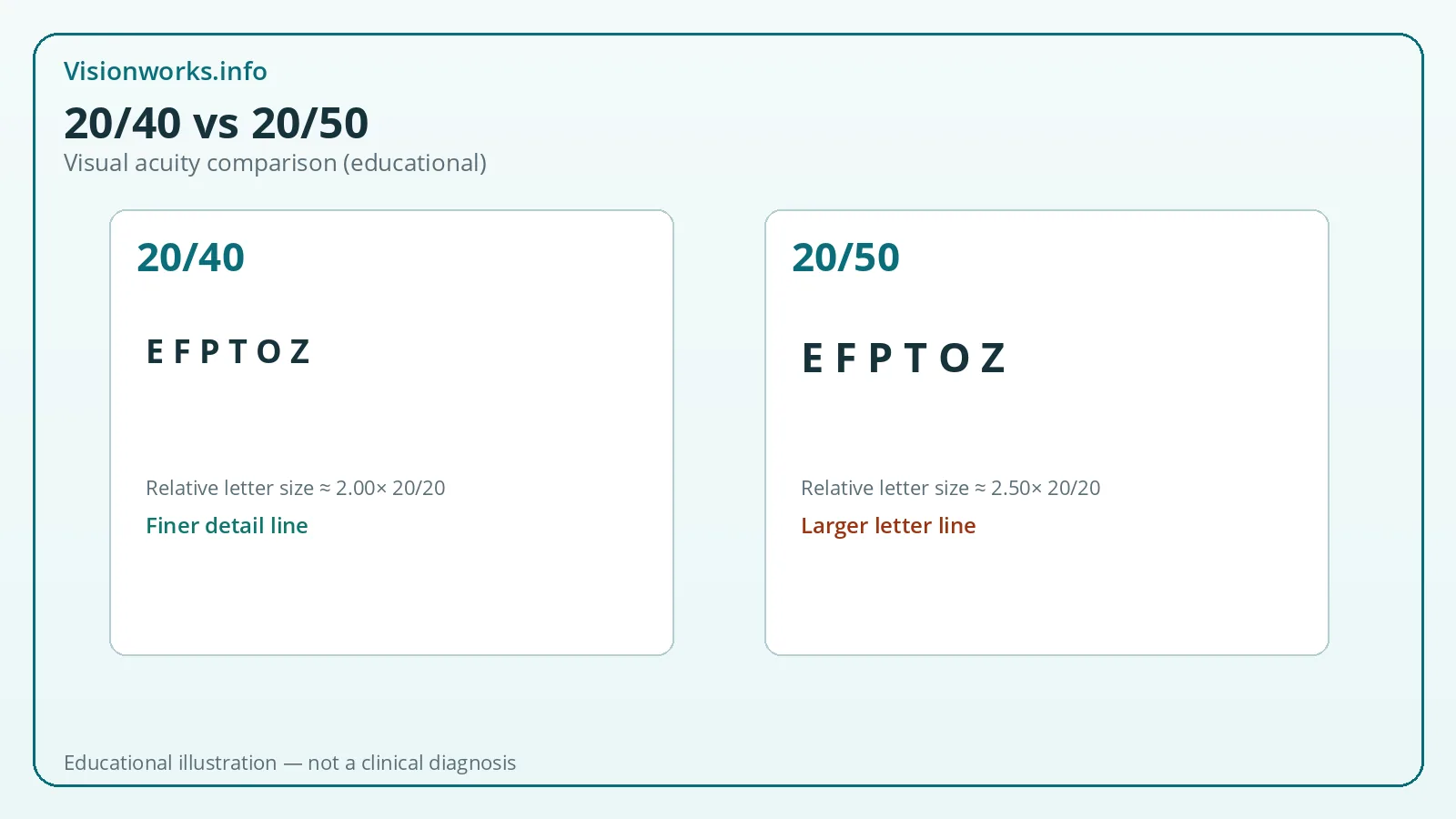
20/40 and 20/50 are neighboring Snellen-style acuity levels. On a simple geometric reading, 20/50 letters are larger than 20/40 letters (50/20 = 2.5× versus 40/20 = 2× relative to a 20/20 letter size). The gap can matter for a screening threshold, yet it remains only one part of visual function.
Notation details
Approximate companions: 20/40 ≈ 6/12 ≈ decimal 0.5 ≈ logMAR ≈ 0.30; 20/50 ≈ 6/15 ≈ decimal 0.4 ≈ logMAR ≈ 0.40. These are mathematical relationships between notations. They are not diagnoses and not eyeglass prescriptions.
Chart design — crowding, luminance, letter set, and stop rules — can shift measured lines even when someone’s everyday experience feels similar from one day to the next.
Why people compare these lines
Searchers often ask about school screening cutoffs, workplace vision conversations, or whether “one more line” is meaningful. One Snellen line can matter when a form uses a hard cutoff. Everyday function still depends on contrast, lighting, binocular vision, and the task (reading a board versus night driving versus computer work).
Corrected acuity still matters most
If someone is about 20/50 without glasses and improves to 20/20 after refraction, the practical story differs from remaining near 20/50 after best correction. Always ask what was measured, which eye, and whether a full refraction and eye-health evaluation were completed.
Asymmetry between eyes, sudden change, or associated symptoms (pain, redness, flashes, floaters, neurologic signs) changes urgency and should be discussed with a clinician promptly.
What not to infer
Do not infer a specific sphere or cylinder power from 20/40 or 20/50. Do not self-assign contact lens parameters. Do not assume the cause is “just needing glasses.” Reduced acuity has many possible explanations that require examination.
Related reading
See 20/40 vision, 20/50 vision, 20/20 vs 20/40, the acuity converter, and eye chart basics.
Care guidance
New or asymmetric acuity reduction deserves an eye exam. Sudden loss, curtain/shadow phenomena, flashes with many new floaters, trauma, chemical exposure, or neurologic vision changes warrant urgent or emergency evaluation depending on severity and associated symptoms. When unsure, contact an eye-care professional or emergency services promptly rather than waiting on an online comparison.
How big is one line in practice?
Moving from 20/40 to 20/50 is often “about one line” on many charts, but line spacing and chart type are not identical everywhere. A single-line change can be within test-retest variability for some people, especially with dry eye, fatigue, or inconsistent lighting.
That is why clinicians look at trends, symptoms, and best-corrected results rather than one isolated screening number from a phone.
Educational examples without prescriptions
Someone might notice highway signs later than a passenger, or need a closer seat in a lecture hall. Those stories can motivate an exam. They do not tell you the sphere, cylinder, axis, or ADD values that belong on a prescription, and they do not identify disease.
FAQ-style clarifications
Is 20/50 much worse than 20/40? It is a larger letter size on the chart idea, but “much worse” depends on correction status and the visual tasks you care about.
Should I update glasses based on this page? No. Glasses changes require a professional refraction and an appropriate eye examination.
Where can I learn chart limits? See eye chart limitations and the educational acuity tool.
Using both numbers in a care conversation
If a screening form lists 20/40 in one eye and 20/50 in the other, bring that printout to an eye exam and ask for best-corrected acuity plus an eye-health evaluation. Asymmetry can be important even when both numbers seem “close.”
Also note the date, which eye, and whether glasses were worn. Those details prevent mixing old screening results with new symptoms.
Educational pages like this one exist to clarify notation and reduce confusion — not to replace measured clinical data. If your visual demands include night driving, detailed computer work, or safety-sensitive tasks, mention those goals during the exam so testing can address them.