
Quick answer
20/20 and 20/40 describe different levels of detail resolution on a Snellen-style chart idea. Someone who reads the 20/20 line at the chart’s reference distance is resolving finer detail than someone whose best line under comparable conditions is 20/40. That comparison is about letter size and resolution under test conditions — not a complete description of eye health, comfort, or night vision.
If you are comparing numbers from a screening, ask whether the result was with glasses, without glasses, or with best refraction. Those details change the meaning of the comparison.
What each number means
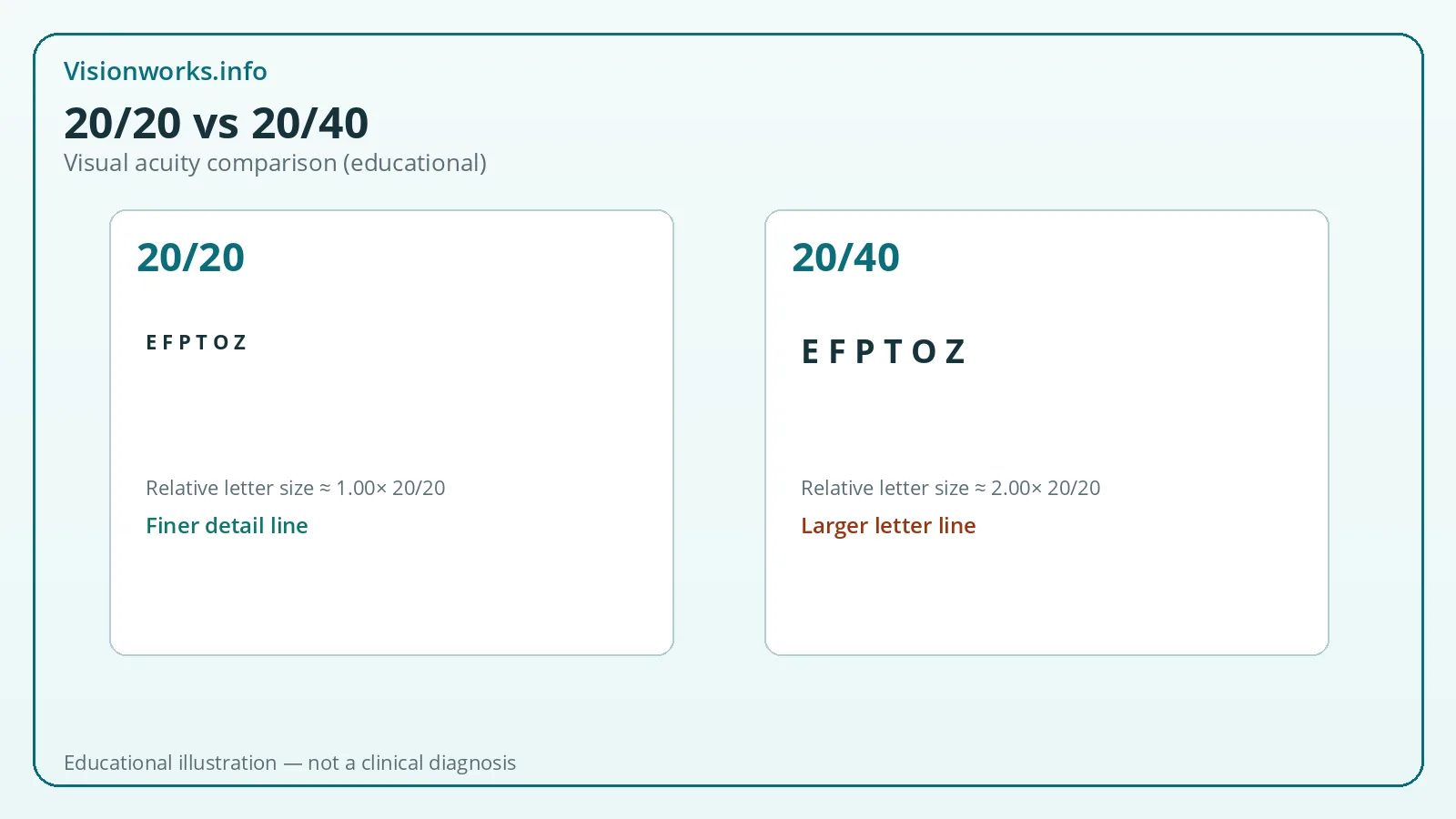
In common U.S. Snellen notation, the first number (20) is the reference testing distance in feet. The second number identifies the line size. A 20/20 line uses letters sized for that reference. A 20/40 line uses letters twice as large on a simple geometric reading of the denominator (40 ÷ 20 = 2).
Useful companion notations often taught with these values include: 20/20 ≈ 6/6 ≈ decimal 1.0 ≈ logMAR 0; 20/40 ≈ 6/12 ≈ decimal 0.5 ≈ logMAR ≈ 0.3. Rounding conventions can vary slightly by clinic, chart manufacturer, and scoring rules.
Metric charts (6/x) and logMAR charts are designed with related geometry, but they are still clinical tests with lighting, crowding, and stop-rule details that matter.
Corrected vs uncorrected acuity
A person may measure near 20/40 without glasses and near 20/20 with an updated refraction. Another person may remain reduced after best correction, which raises a different clinical pathway (ocular health evaluation rather than “just needs stronger glasses”).
Pinhole testing, if used, can hint whether optical blur is a major contributor, but it is not a diagnosis by itself. Online tools cannot perform a refraction or eye-health exam.
What this comparison does not mean
Seeing “better than” or “worse than” another acuity line is not a diagnosis. Two people with measured 20/40 acuity can have different causes, including uncorrected refractive error, tear-film instability, cataract, amblyopia history, macular disease, optic nerve disease, and other conditions.
Acuity also does not describe peripheral vision, color vision, contrast sensitivity, depth perception, binocular comfort, or glare disability. Do not convert either acuity number into an eyeglass prescription. Diopters and Snellen acuity are different measurements and are not interchangeable on a website.
Everyday tasks and expectations
People often associate 20/20 with crisp distance detail and 20/40 with needing to move closer to signs or screens. Those associations can be directionally helpful for education, but lighting, contrast, motion, and fatigue change real-world performance. A classroom whiteboard, highway sign, and phone screen are different visual tasks.
Driving and legal standards
Some licensing conversations mention 20/40-class acuity, but U.S. driver-vision rules vary by state and may include field-of-vision and corrective-lens requirements. A website cannot certify driving fitness. Use your state DMV or licensing authority and clinical measurements from an eye-care professional.
Related tools and pages
Explore the 20/20 and 20/40 explainers, the Snellen converter, and the educational visual acuity tool. For chart limitations on phones and computers, see eye chart limitations.
When to seek care
Schedule a comprehensive eye exam for new blur, difficulty with night driving, headaches tied to visual tasks, or any unexplained acuity change. Seek urgent or emergency care for sudden vision loss, a curtain or shadow over vision, new flashes with many floaters, chemical exposure, significant trauma, or sudden neurologic vision symptoms. Not every change requires emergency services; urgency depends on the full symptom pattern.
How clinicians usually talk about the gap
In clinic, the difference between 20/20 and 20/40 is often discussed as multiple Snellen lines. That can matter for screening cutoffs, occupational vision conversations, or documenting change over time. It still is not a standalone explanation of symptoms such as headache, eye strain, or night glare.
If acuity improved after refraction, the educational takeaway is often that optical blur was a major contributor. If it did not, clinicians look further. Online comparisons cannot perform either step.
FAQ-style clarifications
Is 20/40 “bad”? “Bad” is not a clinical grade. 20/40 is coarser than 20/20 on a chart idea, but significance depends on correction status, symptoms, and eye health findings.
Can glasses always make 20/40 into 20/20? Often refractive correction helps when optical blur is the main issue, but not always. Disease, amblyopia, and other factors can limit best-corrected acuity.
Which page should I read first? Start with the individual 20/40 and 20/20 explainers, then return here for the comparison.