
Distance PD basics
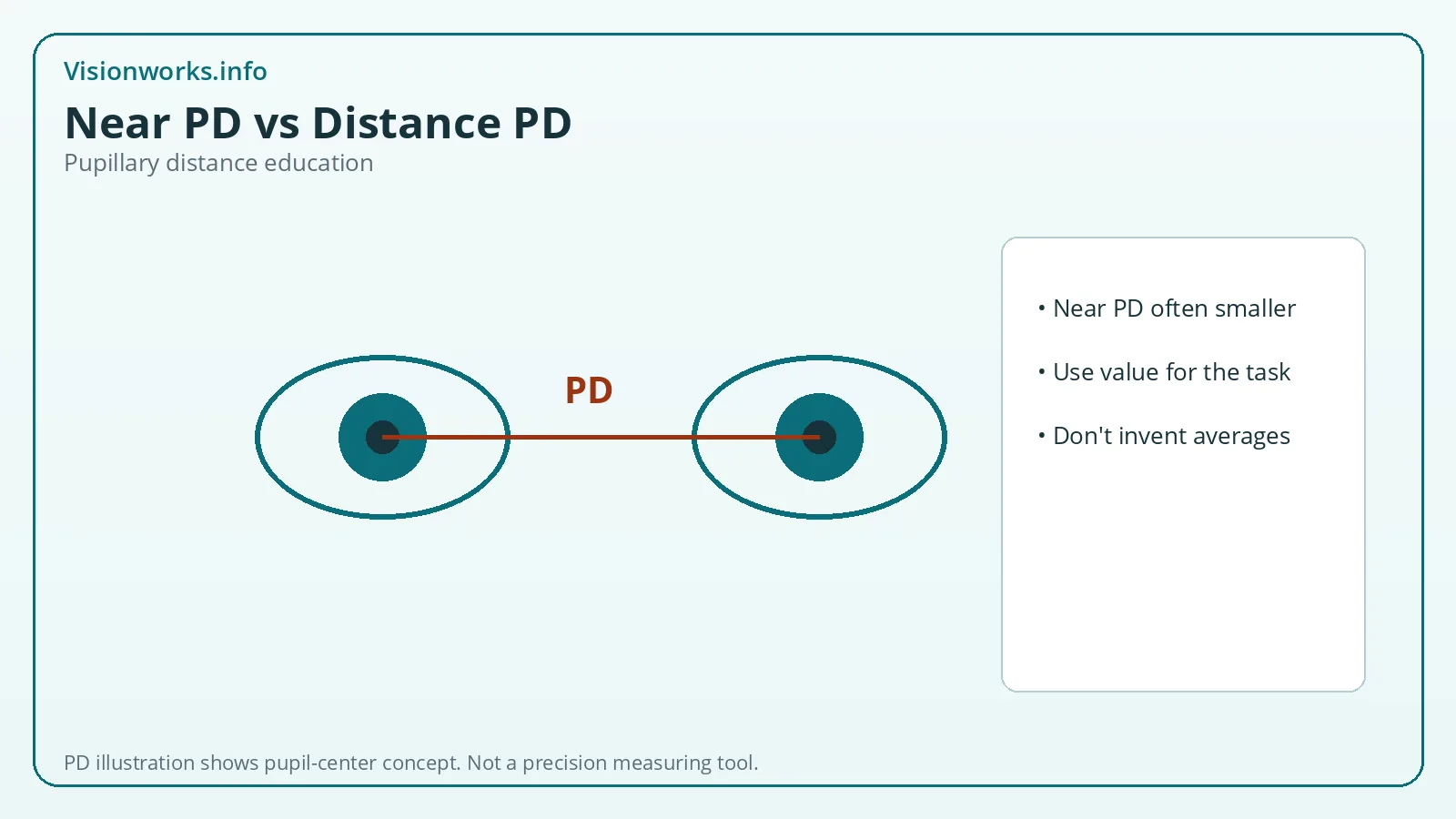
Distance PD relates to pupils when viewing far fixation targets used in standard optical measurement contexts. (Context page: /pd/near-vs-distance/).
Many everyday single-vision distance glasses conversations start with distance PD.
It is still a centering measurement, not a refractive power.
Near PD basics
Near PD is often slightly smaller because eyes converge for near fixation. (Context page: /pd/near-vs-distance/).
Reading and some progressive fitting contexts care about near geometry.
Using a distance PD unchanged for a near-only design can be a mismatch depending on professional guidance.
Why learners mix them up
Online forms may ask for “PD” without specifying near or distance. (Context page: /pd/near-vs-distance/).
People reuse one number for every order even when lens type changes.
Children and adults can show different practical needs; measurement still belongs with professionals for critical lenses.
Fitting implications
Progressive lenses involve complex optical zones; follow dispenser guidance rather than forum arithmetic. (Context page: /pd/near-vs-distance/).
Prism and higher powers increase the cost of wrong geometry.
Frame fit (vertex, pantoscopic tilt, wrap) interacts with PD—numbers alone are not the whole fitting story.
Myths
Myth: near PD should equal distance PD always. (Context page: /pd/near-vs-distance/).
Myth: you can scale PD from phone screen width.
Myth: near PD treats presbyopia without ADD.
Practical questions to ask
“Was this PD measured for distance or near?” (Context page: /pd/near-vs-distance/).
“Do you need monocular values for this lens?”
“Should I be re-measured for this frame?”
Related pages
Single-vs-dual PD explains binocular versus monocular formats. (Context page: /pd/near-vs-distance/).
How-to-measure covers why professional tools beat DIY.
ADD education helps when near optics questions go beyond PD alone.
What this educational page will not do
It will not prescribe lenses, diagnose disease, or convert diopters into a guaranteed Snellen fraction for your eyes. (Context page: /pd/near-vs-distance/).
It will not settle driving legality; state rules vary [near-vs-distance].
It will not replace a comprehensive exam when symptoms are new, asymmetric, or paired with eye-health risk factors such as diabetes [near-vs-distance].
Putting this page to work
Learners reading /pd/near-vs-distance/ usually want clarity without being upsold fear. This section adds practical literacy without inventing a personal diagnosis.
For /pd/near-vs-distance/, keep three folders in mind: what the notation means, what it does not mean (especially Snellen conversion myths), and when to escalate from curiosity to a real appointment.
If you reached /pd/near-vs-distance/ from a search about sudden symptoms—vision loss, curtains, flashes with many floaters, severe pain, chemicals, or trauma—prioritize urgent clinical triage over finishing an educational article.
If your interest in /pd/near-vs-distance/ is gradual blur, overdue glasses, or paperwork confusion, plan a comprehensive exam and bring prior glasses plus printouts so comparisons are fair.
Visionworks.info remains independent educational media for pages like /pd/near-vs-distance/: not a clinic, not a retailer, and not affiliated with Visionworks stores or VSP Vision.
State driving rules can come up beside topics like /pd/near-vs-distance/; they vary and this site does not provide legal clearance or disqualification.
Extra literacy notes for /pd/near-vs-distance/
Readers comparing notes on /pd/near-vs-distance/ sometimes stop at a single slogan. Add one more habit: write down which eye, which correction, and which chart or measurement tool produced the number you are worrying about.
If family members disagree about what was said at an appointment regarding /pd/near-vs-distance/, request a printed summary instead of reconstructing details from memory during an online order.
Educational pages like /pd/near-vs-distance/ are strongest when paired with a real exam plan—especially for children, for people with diabetes, and for anyone with sudden symptom changes.
When professional care matters
If glasses are uncomfortable despite an updated refraction, ask a professional to recheck centration and PD rather than randomly editing millimeters at home [near-vs-distance].
Urgent or emergency evaluation is appropriate for sudden vision loss, a curtain or shadow over part of vision, new flashes with many floaters, severe eye pain, chemical splash, or trauma. Stable long-standing questions about /pd/near-vs-distance/ usually belong in planned appointments—while rapid new change still deserves prompt triage.