
Overview
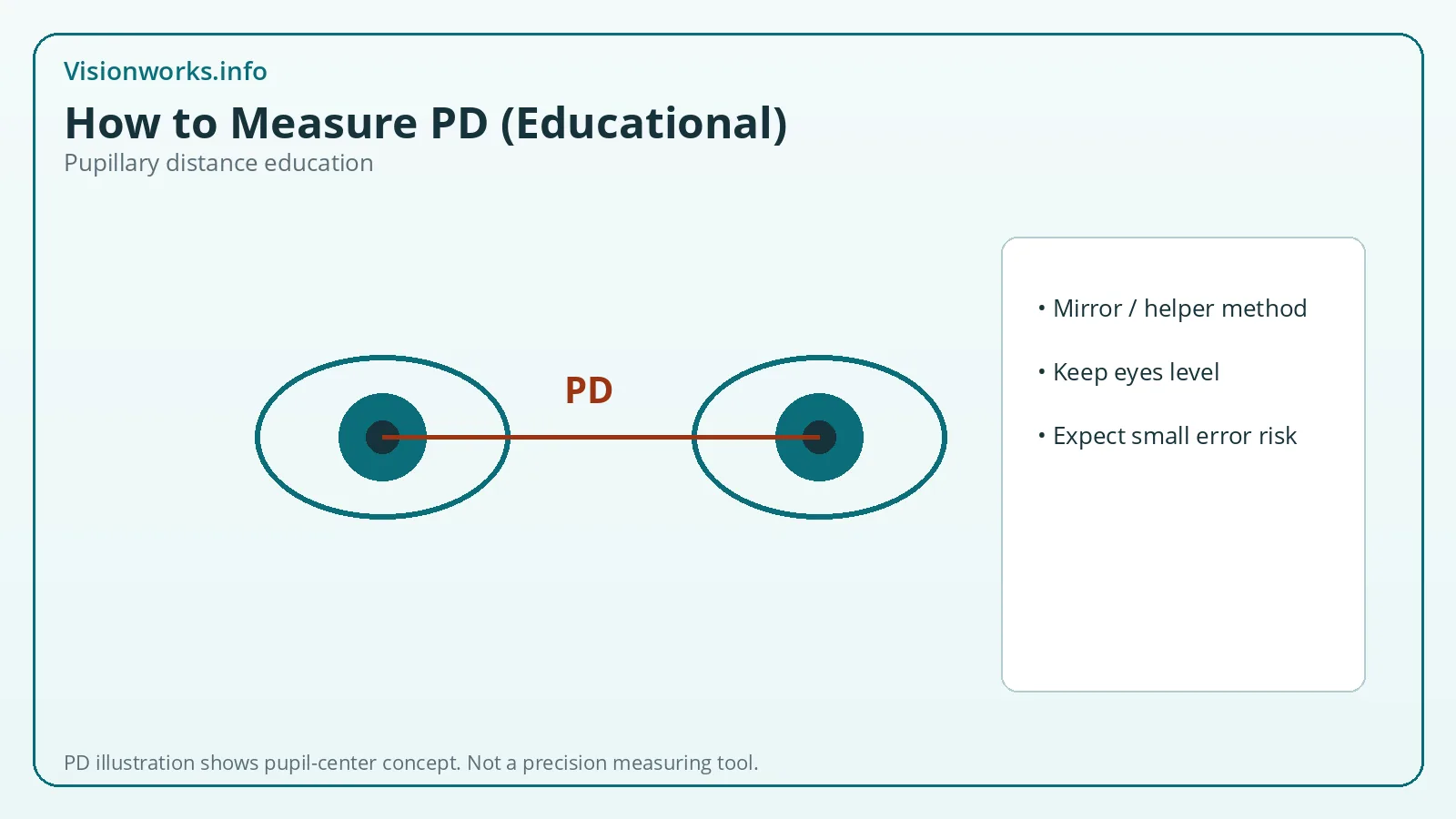
Pupillary distance (PD) supports optical centering. Professional measurement with a pupillometer or calibrated system is preferred—especially for progressives, prism, and higher powers. (Context page: /pd/how-to-measure/).
Home methods using a mirror and millimeter ruler are rough educational exercises prone to parallax error and inconsistent landmark choice.
This page teaches concepts; it is not a certification that your home number is fabrication-ready for every lens type.
Why professionals measure differently
Instruments stabilize alignment and reduce parallax compared with bathroom-mirror attempts. (Context page: /pd/how-to-measure/).
Monocular PDs capture asymmetry that a single binocular guess can miss.
Near PD measurement uses different fixation distances than distance PD.
Fitting implications
Never fabricate a PD to bypass optical requirements. Incorrect centration can cause discomfort, swim, or reduced clarity. (Context page: /pd/how-to-measure/).
Progressive corridors and prism-containing lenses are less forgiving of centration mistakes than some simple single-vision readers.
Higher powers magnify the consequences of small PD errors.
Educational home-method caveats
If you experiment at home for learning, use good lighting, avoid leaning toward the mirror, and do not treat the result as definitive. (Context page: /pd/how-to-measure/).
Selfie apps vary widely; prefer professional measurement for critical fittings.
Children should not be DIY-measured as a substitute for pediatric optical care.
Myths
PD is not a diagnosis. Changing PD does not treat refractive error. Copying a friend’s PD is unsafe. (Context page: /pd/how-to-measure/).
“Average PD” charts are not your face.
PD is not a Snellen fraction and not a sphere power.
What to bring to dispensing
Ask whether your order needs binocular PD, monocular PDs, or both. (Context page: /pd/how-to-measure/).
Bring prior glasses if they were comfortable—centration clues help professionals.
If an online seller requires PD but your medical Rx omits it, ask the clinic or dispenser how they handle measurement.
Related Visionworks.info pages
Read single-vs-dual, near-vs-distance, and average-PD explainers for neighboring concepts. (Context page: /pd/how-to-measure/).
Prescription PD field education lives under /prescription/pd/ as well.
Acuity pages will not give you a PD—different measurement family entirely.
What this educational page will not do
It will not prescribe lenses, diagnose disease, or convert diopters into a guaranteed Snellen fraction for your eyes. (Context page: /pd/how-to-measure/).
It will not settle driving legality; state rules vary [how-to-measure].
It will not replace a comprehensive exam when symptoms are new, asymmetric, or paired with eye-health risk factors such as diabetes [how-to-measure].
Putting this page to work
Learners reading /pd/how-to-measure/ usually want clarity without being upsold fear. This section adds practical literacy without inventing a personal diagnosis.
For /pd/how-to-measure/, keep three folders in mind: what the notation means, what it does not mean (especially Snellen conversion myths), and when to escalate from curiosity to a real appointment.
If you reached /pd/how-to-measure/ from a search about sudden symptoms—vision loss, curtains, flashes with many floaters, severe pain, chemicals, or trauma—prioritize urgent clinical triage over finishing an educational article.
If your interest in /pd/how-to-measure/ is gradual blur, overdue glasses, or paperwork confusion, plan a comprehensive exam and bring prior glasses plus printouts so comparisons are fair.
Visionworks.info remains independent educational media for pages like /pd/how-to-measure/: not a clinic, not a retailer, and not affiliated with Visionworks stores or VSP Vision.
State driving rules can come up beside topics like /pd/how-to-measure/; they vary and this site does not provide legal clearance or disqualification.
When professional care matters
If glasses are uncomfortable despite an updated refraction, ask a professional to recheck centration and PD rather than randomly editing millimeters at home [how-to-measure].
Urgent or emergency evaluation is appropriate for sudden vision loss, a curtain or shadow over part of vision, new flashes with many floaters, severe eye pain, chemical splash, or trauma. Stable long-standing questions about /pd/how-to-measure/ usually belong in planned appointments—while rapid new change still deserves prompt triage.