
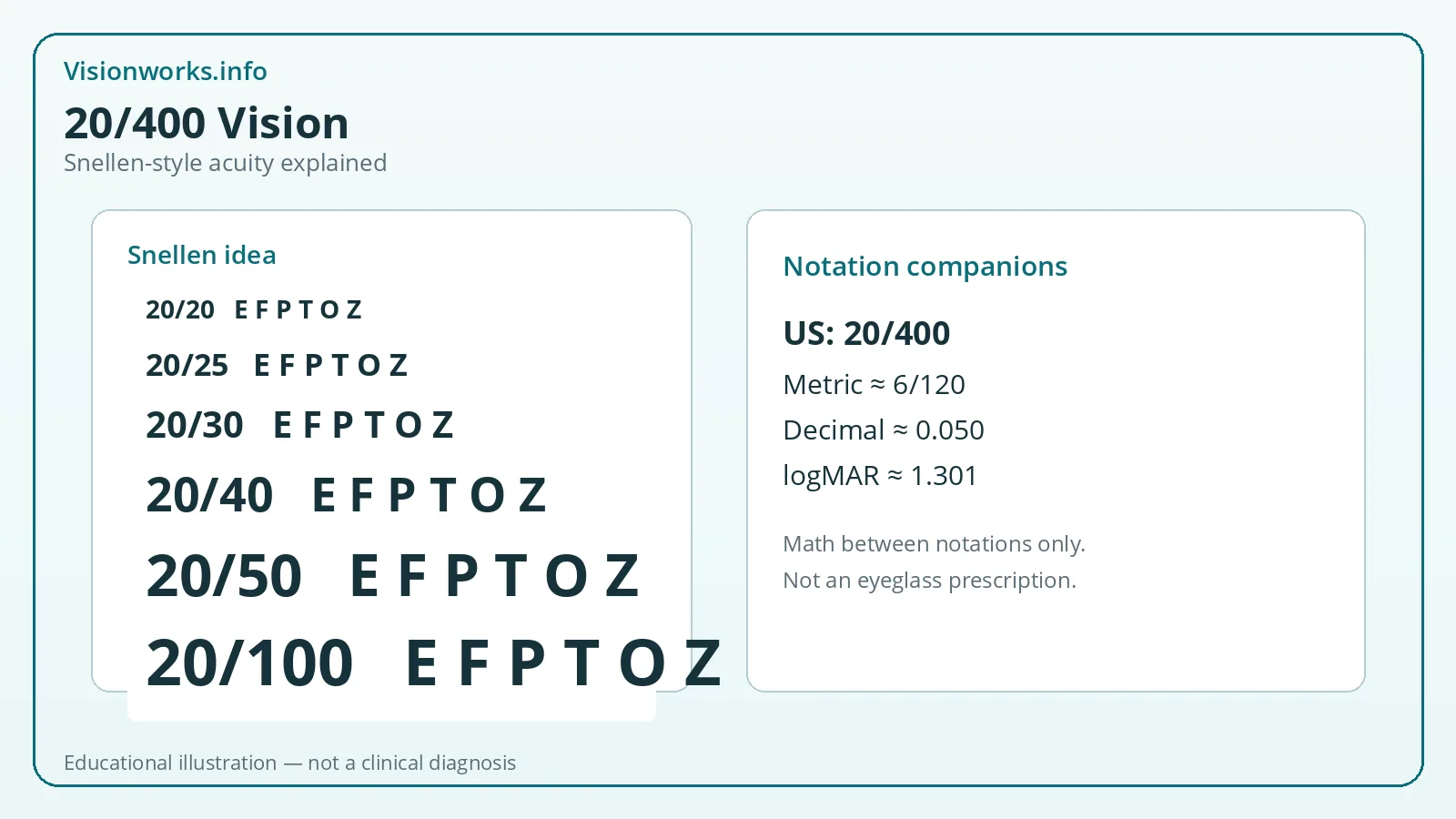
What 20/400 means
20/400 means that at a 20-foot teaching reference you resolved letters sized for the 400-foot line—extremely reduced on Snellen letter-size geometry. (Context page: /vision/20-400/).
Companion notations often taught with 20/400 include decimal ≈ 0.05, logMAR ≈ 1.301, and metric near 6/120, with rounding differences by source.
On a simple geometric reading, 20/400 letters are about 20× the linear size of 20/20 letters at the same distance.
- US Snellen-style: 20/400
- Metric approx: 6/120
- Decimal approx: 0.05
- logMAR approx: 1.301
- Letter-size factor vs 20/20: 20×
In short, 20/400 is extremely reduced on Snellen letter-size geometry when testing conditions are comparable.
Numerator, denominator, and testing distance
Keep both parts of 20/400: the leading 20 is the distance reference idea, while 400 labels the letter-size line. (Context page: /vision/20-400/).
If a clinic tested at another calibrated distance and reported a 20/400 equivalent, that conversion assumes proper optotype design—unlike phone apps claiming 20/400.
Crowding bars and letter-by-letter scoring rules influence whether offices write exactly 20/400 for borderline performances.
Compared with neighboring fractions, 20/400 sits at denominator 400, so letter-size steps up or down change what distant detail you can resolve under similar lighting.
What this acuity does and does not mean
20/400 is not a personal failure narrative. (Context page: /vision/20-400/).
Regarding eye health and function, 20/400 not a shopping code for sphere stock.
Also, 20/400 not the only independence metric.
Corrected versus uncorrected results
For 20/400 specifically, best-corrected data guide medical/rehab planning. (Context page: /vision/20-400/).
When interpreting 20/400, remember uncorrected ultra-blur must not be misread as final destiny.
Additional 20/400 context: support tools should be matched to goals by specialists.
Everyday context for 20/400
Everyday 20/400 stories often involve auditory cues and tactile markers joining daily strategy. (Context page: /vision/20-400/).
Another 20/400 angle: describing residual light/shape skills precisely.
About driving and rules for people discussing 20/400: transportation/benefits questions belonging with agencies and clinicians. Visionworks.info is not legal advice.
Teachers, coaches, and employers sometimes misuse 20/400 as a catch-all vision grade; clinically it is only one high-contrast measurement.
Common misconceptions
Misconception about 20/400: exams are pointless at 20/400. (Context page: /vision/20-400/).
Misconception about 20/400: urgent and routine pathways are identical.
Misconception about 20/400: children only need closer seats.
Relationship to glasses prescriptions
Visionworks.info will not claim that 20/400 equals one universal diopter prescription for every person. (Context page: /vision/20-400/).
Use educational converters to practice notation around 20/400; use clinicians for refraction and medical decisions.
Acuity line 20/400 and diopter fields answer different questions even when both appear on the same visit summary.
If someone quotes 20/400 from a hallway screening, treat it as a prompt for a comprehensive exam rather than a final identity label.
Putting this page to work
Learners reading /vision/20-400/ usually want clarity without being upsold fear. This section adds practical literacy without inventing a personal diagnosis.
For /vision/20-400/, keep three folders in mind: what the notation means, what it does not mean (especially Snellen conversion myths), and when to escalate from curiosity to a real appointment.
If you reached /vision/20-400/ from a search about sudden symptoms—vision loss, curtains, flashes with many floaters, severe pain, chemicals, or trauma—prioritize urgent clinical triage over finishing an educational article.
If your interest in /vision/20-400/ is gradual blur, overdue glasses, or paperwork confusion, plan a comprehensive exam and bring prior glasses plus printouts so comparisons are fair.
Visionworks.info remains independent educational media for pages like /vision/20-400/: not a clinic, not a retailer, and not affiliated with Visionworks stores or VSP Vision.
State driving rules can come up beside topics like /vision/20-400/; they vary and this site does not provide legal clearance or disqualification.
When professional care matters
If screening paperwork shows 20/400 and you lack a recent comprehensive exam—especially for children or diabetes—schedule clinical care rather than relying on hallway numbers.
Urgent or emergency evaluation is appropriate for sudden vision loss, a curtain or shadow over part of vision, new flashes with many floaters, severe eye pain, chemical splash, or trauma. Stable long-standing questions about /vision/20-400/ usually belong in planned appointments—while rapid new change still deserves prompt triage.