
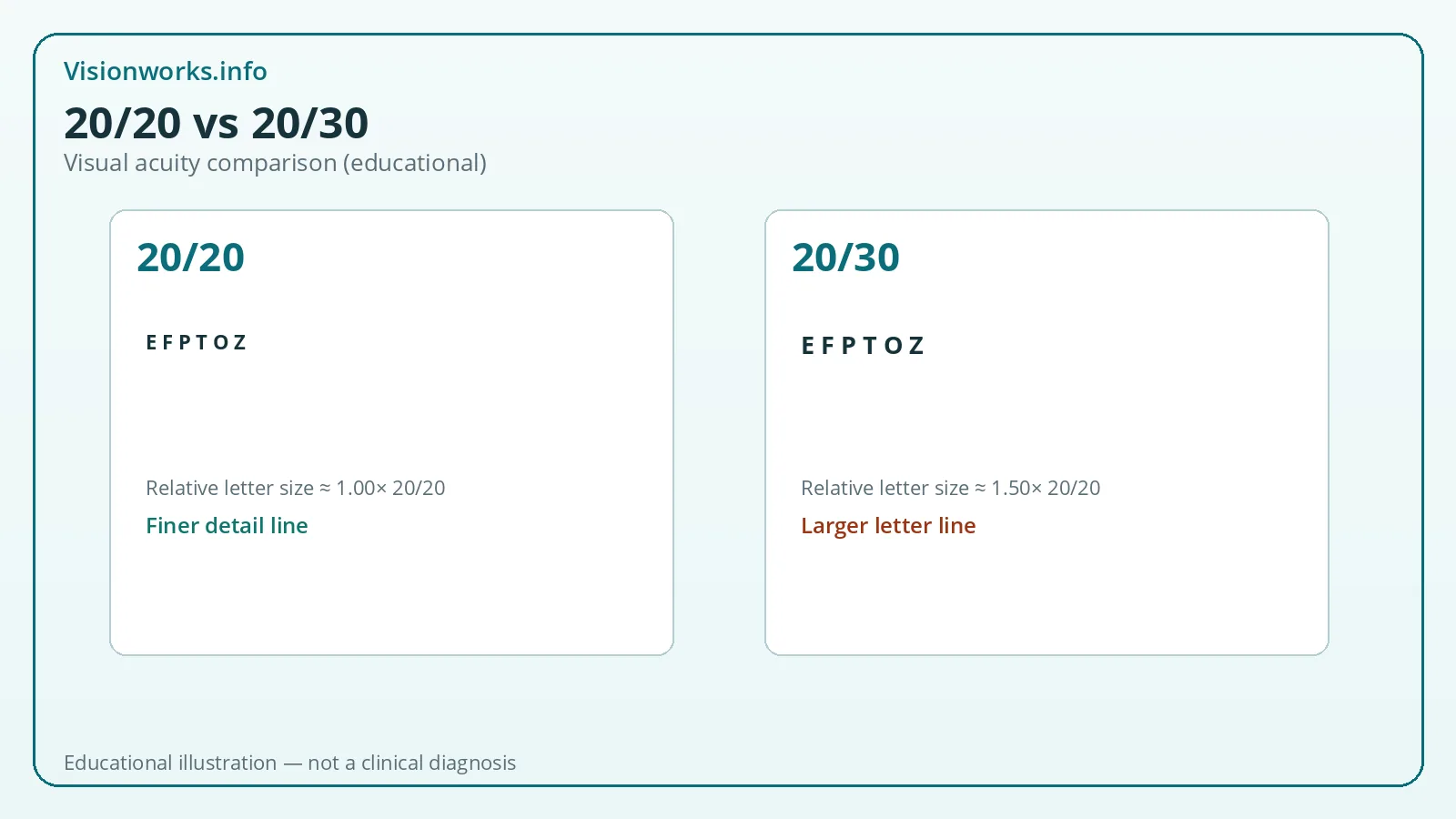
Direct comparison
20/30 letters are larger than 20/20 letters at the same reference—about 1.5× on a simple geometric denominator reading. (Context page: /vision/20-20-vs-20-30/).
Companions: 20/20 ≈ decimal 1.0 / logMAR 0.0 / metric 6/6; 20/30 ≈ decimal 0.67 / logMAR 0.18 / metric 6/9.
The gap is big enough that distant boards may feel different, yet small enough that people delay care if near tasks still feel easy.
Scoring strictness can move someone between these neighboring lines without a dramatic real-world collapse.
School and workplace screenings
Pediatric screenings often flag results near 20/30 or worse for follow-up. A flag invites a comprehensive exam, not a final DIY prescription. (Context page: /vision/20-20-vs-20-30/).
Adult workplace checks that only test both eyes together can miss a monocular 20/30 problem.
Classroom seating changes can help function temporarily while you arrange proper care for a child.
What neither number proves
Neither 20/20 nor 20/30 proves eye disease is absent or present. (Context page: /vision/20-20-vs-20-30/).
Neither is a sphere value—avoid blogs that stamp −1.00 on every 20/30 forehead.
Neither replaces binocular vision testing or ocular health evaluation.
Corrected vs uncorrected framing for this pair
Uncorrected mild myopia producing 20/30 is a different path than best-corrected 20/30 from amblyopia or retinal disease. (Context page: /vision/20-20-vs-20-30/).
Bring old glasses so habitual versus best-corrected comparisons are honest.
Pediatric cooperation issues can mimic a 20/30 result on a noisy screening day.
Driving and legal caveats
Some jurisdictions discuss acuity thresholds near common fractions; others differ, and correction may be required. (Context page: /vision/20-20-vs-20-30/).
Visionworks.info does not certify driving ability for either 20/20 or 20/30.
Teen drivers need official standards and clinical measurements, not sibling comparisons.
Practical next steps after seeing both numbers
If you moved from 20/20 toward 20/30, prioritize an exam over waiting for “something worse.” (Context page: /vision/20-20-vs-20-30/).
Ask for monocular results even when binocular reading feels acceptable.
Keep copies of screenings and clinic printouts to track true trends.
Putting this page to work
Learners reading /vision/20-20-vs-20-30/ usually want clarity without being upsold fear. This section adds practical literacy without inventing a personal diagnosis.
For /vision/20-20-vs-20-30/, keep three folders in mind: what the notation means, what it does not mean (especially Snellen conversion myths), and when to escalate from curiosity to a real appointment.
If you reached /vision/20-20-vs-20-30/ from a search about sudden symptoms—vision loss, curtains, flashes with many floaters, severe pain, chemicals, or trauma—prioritize urgent clinical triage over finishing an educational article.
If your interest in /vision/20-20-vs-20-30/ is gradual blur, overdue glasses, or paperwork confusion, plan a comprehensive exam and bring prior glasses plus printouts so comparisons are fair.
Visionworks.info remains independent educational media for pages like /vision/20-20-vs-20-30/: not a clinic, not a retailer, and not affiliated with Visionworks stores or VSP Vision.
State driving rules can come up beside topics like /vision/20-20-vs-20-30/; they vary and this site does not provide legal clearance or disqualification.
Extra literacy notes for /vision/20-20-vs-20-30/
Readers comparing notes on /vision/20-20-vs-20-30/ sometimes stop at a single slogan. Add one more habit: write down which eye, which correction, and which chart or measurement tool produced the number you are worrying about.
If family members disagree about what was said at an appointment regarding /vision/20-20-vs-20-30/, request a printed summary instead of reconstructing details from memory during an online order.
Educational pages like /vision/20-20-vs-20-30/ are strongest when paired with a real exam plan—especially for children, for people with diabetes, and for anyone with sudden symptom changes.
When professional care matters
Children flagged on school screenings deserve a full exam even if grades remain strong.
Urgent or emergency evaluation is appropriate for sudden vision loss, a curtain or shadow over part of vision, new flashes with many floaters, severe eye pain, chemical splash, or trauma. Stable long-standing questions about /vision/20-20-vs-20-30/ usually belong in planned appointments—while rapid new change still deserves prompt triage.