
Direct comparison
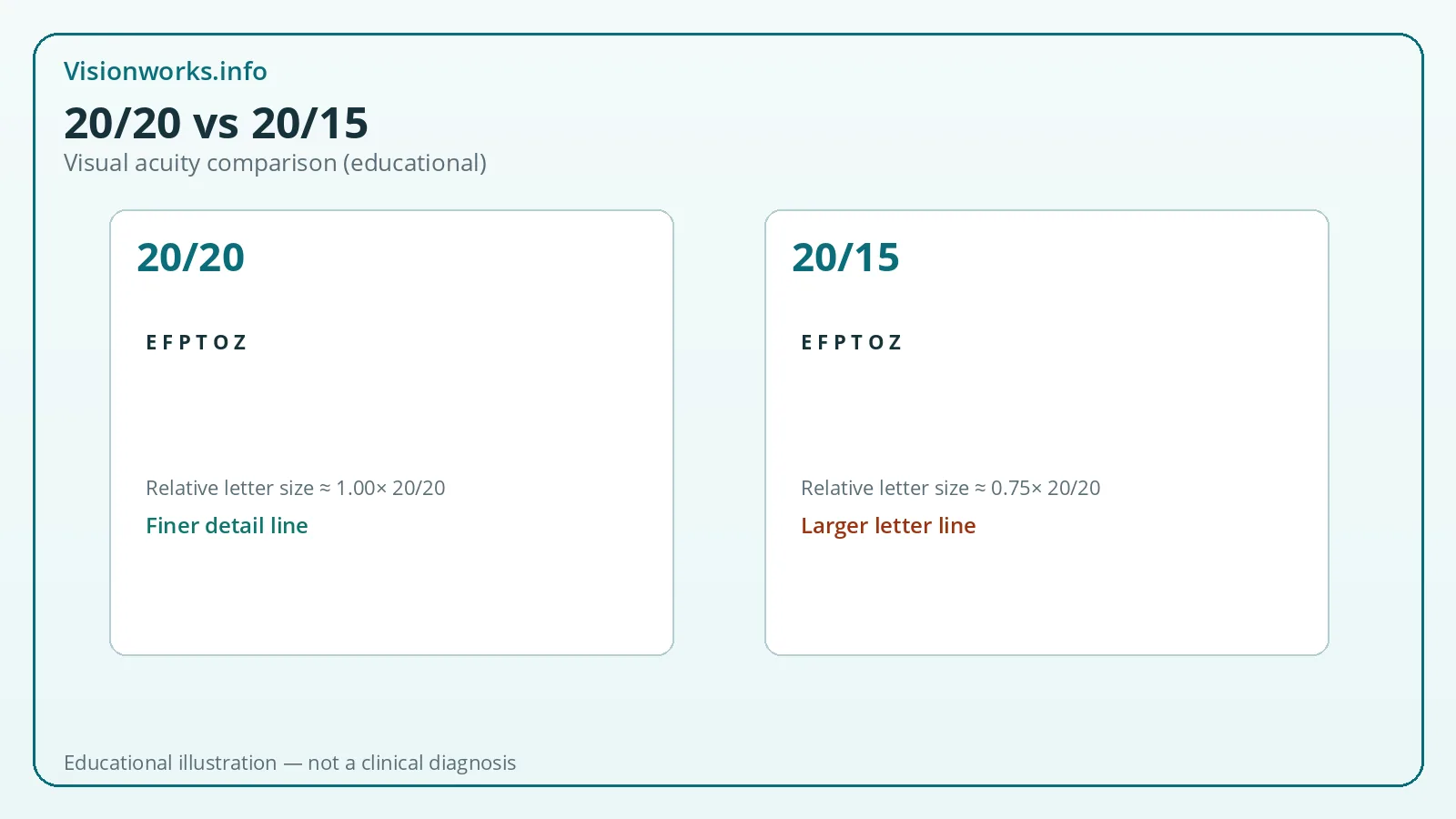
20/15 resolves finer detail than 20/20 under comparable Snellen-style ideas because the 15 line uses smaller letters than the 20 line at the same reference distance. (Context page: /vision/20-20-vs-20-15/).
Approximate companions: 20/20 → decimal 1.0, logMAR 0.0, metric ~6/6; 20/15 → decimal ~1.33, logMAR ~−0.12, metric ~6/4.5.
Geometrically, 20/15 letters are about 0.75× the size of 20/20 letters. That is a clarity step, not a personality ranking between patients.
Clinics may still round or score borderline letters differently, so two offices can disagree slightly even when vision feels unchanged.
What people often misunderstand about this pair
Landing on 20/20 is not a failure relative to a friend who measures 20/15. The 20/20 line remains a widely used reference for clear distance letters. (Context page: /vision/20-20-vs-20-15/).
Neither fraction prints a glasses prescription. Diopters live on another axis of measurement entirely.
Bright-clinic 20/15 can coexist with night glare complaints; contrast and scatter are not fully captured by the best letter line.
Occupational “must be better than 20/20” folklore is not the same as a medical indication.
Corrected vs uncorrected when comparing friends
Comparisons collapse when one person quotes unaided acuity and another quotes best-corrected acuity after refraction. (Context page: /vision/20-20-vs-20-15/).
Binocular 20/15 with a lazy monocular result is not the same clinical story as symmetrical 20/20 monocular findings.
Contact-lens wear during testing should be disclosed before anyone crowns a winner in a group chat.
Everyday tasks and driving caveats
For many distance tasks, both 20/20 and 20/15 can support comfortable function—especially when optics match the task. (Context page: /vision/20-20-vs-20-15/).
Driving standards are set by states and may reference different cutoffs, sometimes with corrective-lens restrictions. This comparison is not legal advice.
If your work involves tiny distant targets, discuss goals in clinic rather than chasing a trophy fraction from internet forums.
When the difference matters clinically
Change from your own baseline and asymmetry between eyes usually matter more than beating someone else’s 20/15. (Context page: /vision/20-20-vs-20-15/).
Refractive surgery marketing that fetishizes 20/15 still cannot promise your personal outcome on a webpage.
Ask which chart and which eyes were tested before rewriting your self-image around a single comparison.
Prescription myths to reject for 20/20 vs 20/15
No trustworthy personal converter turns either fraction into a unique sphere/cylinder set. (Context page: /vision/20-20-vs-20-15/).
Ordering random lenses to “win” the comparison skips eye-health evaluation.
Contact lens parameters remain separate from acuity bragging rights.
Putting this page to work
Learners reading /vision/20-20-vs-20-15/ usually want clarity without being upsold fear. This section adds practical literacy without inventing a personal diagnosis.
For /vision/20-20-vs-20-15/, keep three folders in mind: what the notation means, what it does not mean (especially Snellen conversion myths), and when to escalate from curiosity to a real appointment.
If you reached /vision/20-20-vs-20-15/ from a search about sudden symptoms—vision loss, curtains, flashes with many floaters, severe pain, chemicals, or trauma—prioritize urgent clinical triage over finishing an educational article.
If your interest in /vision/20-20-vs-20-15/ is gradual blur, overdue glasses, or paperwork confusion, plan a comprehensive exam and bring prior glasses plus printouts so comparisons are fair.
Visionworks.info remains independent educational media for pages like /vision/20-20-vs-20-15/: not a clinic, not a retailer, and not affiliated with Visionworks stores or VSP Vision.
State driving rules can come up beside topics like /vision/20-20-vs-20-15/; they vary and this site does not provide legal clearance or disqualification.
When professional care matters
If one eye measures differently from the other by a wide margin on either line, bring that asymmetry to a professional rather than averaging the story.
Urgent or emergency evaluation is appropriate for sudden vision loss, a curtain or shadow over part of vision, new flashes with many floaters, severe eye pain, chemical splash, or trauma. Stable long-standing questions about /vision/20-20-vs-20-15/ usually belong in planned appointments—while rapid new change still deserves prompt triage.