
Answer first: what OU means
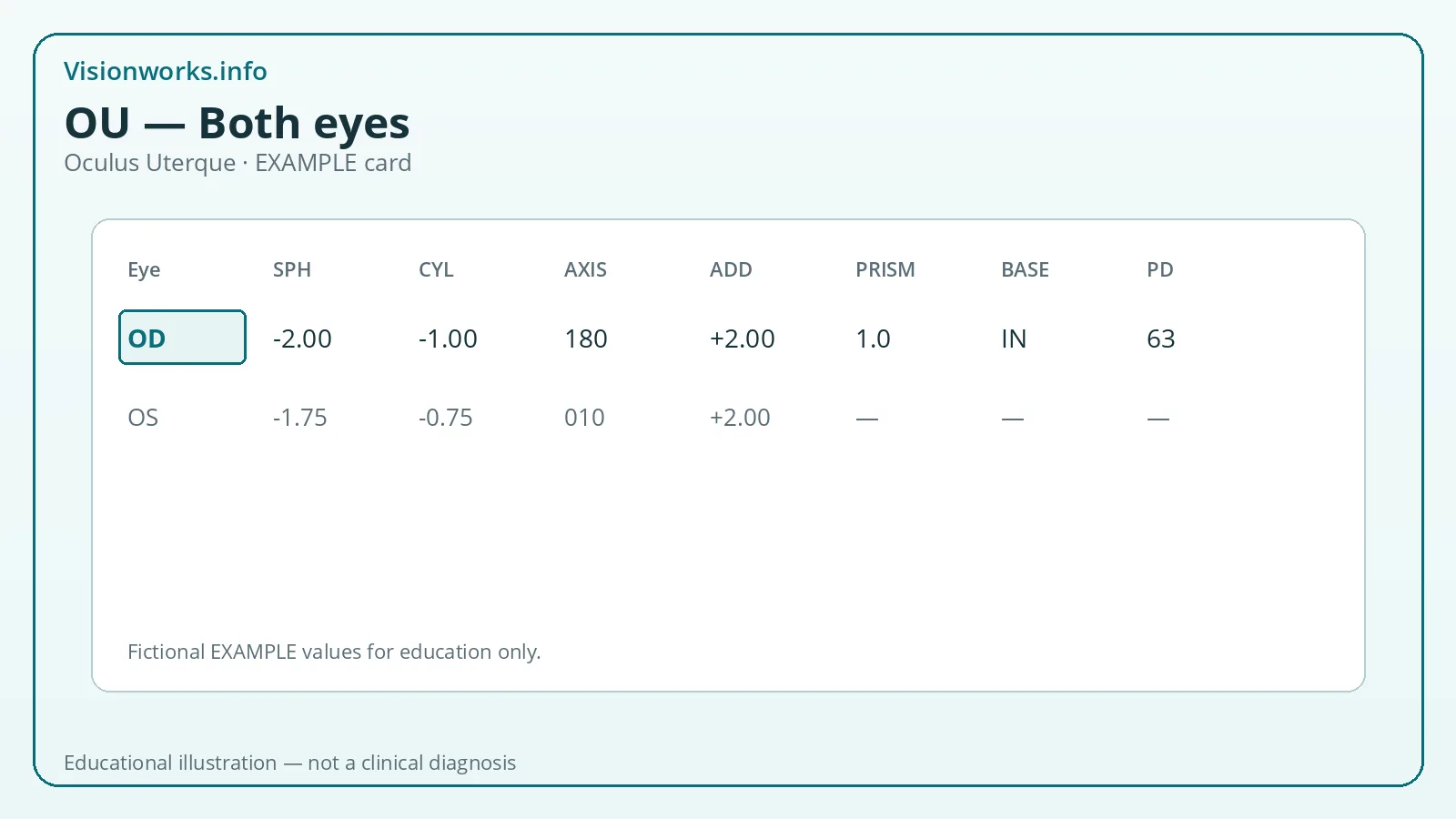
OU stands for oculus uterque and refers to both eyes. On modern spectacle prescriptions you will still usually see separate OD and OS power grids even when an OU note appears elsewhere.
OU may label a shared add power, a binocular finding, or a comment that applies to both eyes. It is not a license to ignore monocular differences.
If a form shows OU prism or OU sphere without OD/OS breakdown, ask the issuing clinic how to interpret fabrication instructions.
Where OU shows up in paperwork
Some older pads use OU columns when powers are identical. Many EHRs still prefer explicit OD and OS rows for safety. (Context page: /prescription/ou/).
Progressive lens orders may include OU height or corridor notes alongside monocular PDs—different jobs on the same ticket.
Contact lens documents may also use OU language; that still does not make a glasses OU note into a contact Rx.
OU versus OD/OS in real life
Binocular acuity can look better than either eye alone, which is why OU comfort and OD/OS powers must be read together. (Context page: /prescription/ou/).
Anisometropia means OU shorthand can hide important imbalances if someone only copies a single shared number.
Prism that is written OU still needs clear base directions for each eye or a clinically explicit combined notation.
Common OU misconceptions
Misconception: “OU means I only need one power for life.” Eyes change and often differ. (Context page: /prescription/ou/).
Misconception: “OU on a receipt means the doctor skipped examining each eye.” It usually means a binocular label, not skipped care—but ask if unclear.
Misconception: “OU diopters equal binocular Snellen acuity.” Diopters and acuity remain different measurements.
How clinicians use OU notes
They may document OU add for near when both eyes share the same addition. (Context page: /prescription/ou/).
They may record OU symptoms (for example, binocular strain) separately from monocular refraction results.
They may caution that OU marketing language in online stores is not a clinical examination.
Practical reading tips
When you see OU, still hunt for OD and OS sphere/cylinder/axis before ordering.
If only OU appears for a power you expected monocularly, request clarification in writing.
Keep binocular PD and monocular PD distinctions straight when OU fitting notes appear.
OU language and visual acuity
People sometimes say “both eyes are 20/20 (OU).” That is an acuity statement, not a prescription field. (Context page: /prescription/ou/).
Do not convert an OU acuity slogan into a shared sphere order.
Ask for monocular acuities when one eye feels weaker despite a cheerful OU phrase.
Binocular notes versus marketing language
Retail phrases like “OU package” are sales language; they do not redefine your clinical OD/OS powers.
Binocular vision testing can influence comfort even when OU acuity slogans look excellent.
If a prior Rx used OU for identical powers and a new Rx splits OD/OS with tiny differences, ask whether measurement precision or true change is involved.
Teaching yourself OU literacy
Translate OU as “both eyes” every time you see it until the habit sticks.
Write a personal glossary on your Rx envelope: OD right, OS left, OU both.
When acuity is reported OU, still ask for monocular lines if one eye feels different.
Putting this page to work
Learners reading /prescription/ou/ usually want clarity without being upsold fear. This section adds practical literacy without inventing a personal diagnosis.
For /prescription/ou/, keep three folders in mind: what the notation means, what it does not mean (especially Snellen conversion myths), and when to escalate from curiosity to a real appointment.
If you reached /prescription/ou/ from a search about sudden symptoms—vision loss, curtains, flashes with many floaters, severe pain, chemicals, or trauma—prioritize urgent clinical triage over finishing an educational article.
If your interest in /prescription/ou/ is gradual blur, overdue glasses, or paperwork confusion, plan a comprehensive exam and bring prior glasses plus printouts so comparisons are fair.
Visionworks.info remains independent educational media for pages like /prescription/ou/: not a clinic, not a retailer, and not affiliated with Visionworks stores or VSP Vision.
State driving rules can come up beside topics like /prescription/ou/; they vary and this site does not provide legal clearance or disqualification.
When professional care matters
Schedule a comprehensive eye exam if questions about OU notation coincide with new blur, headaches tied to visual tasks, night-driving difficulty, or overdue care. Online education cannot replace clinical refraction or eye-health evaluation.
Urgent or emergency evaluation is appropriate for sudden vision loss, a curtain or shadow over part of vision, new flashes with many floaters, severe eye pain, chemical splash, or trauma. Stable long-standing questions about /prescription/ou/ usually belong in planned appointments—while rapid new change still deserves prompt triage.