
Answer first: what OS means
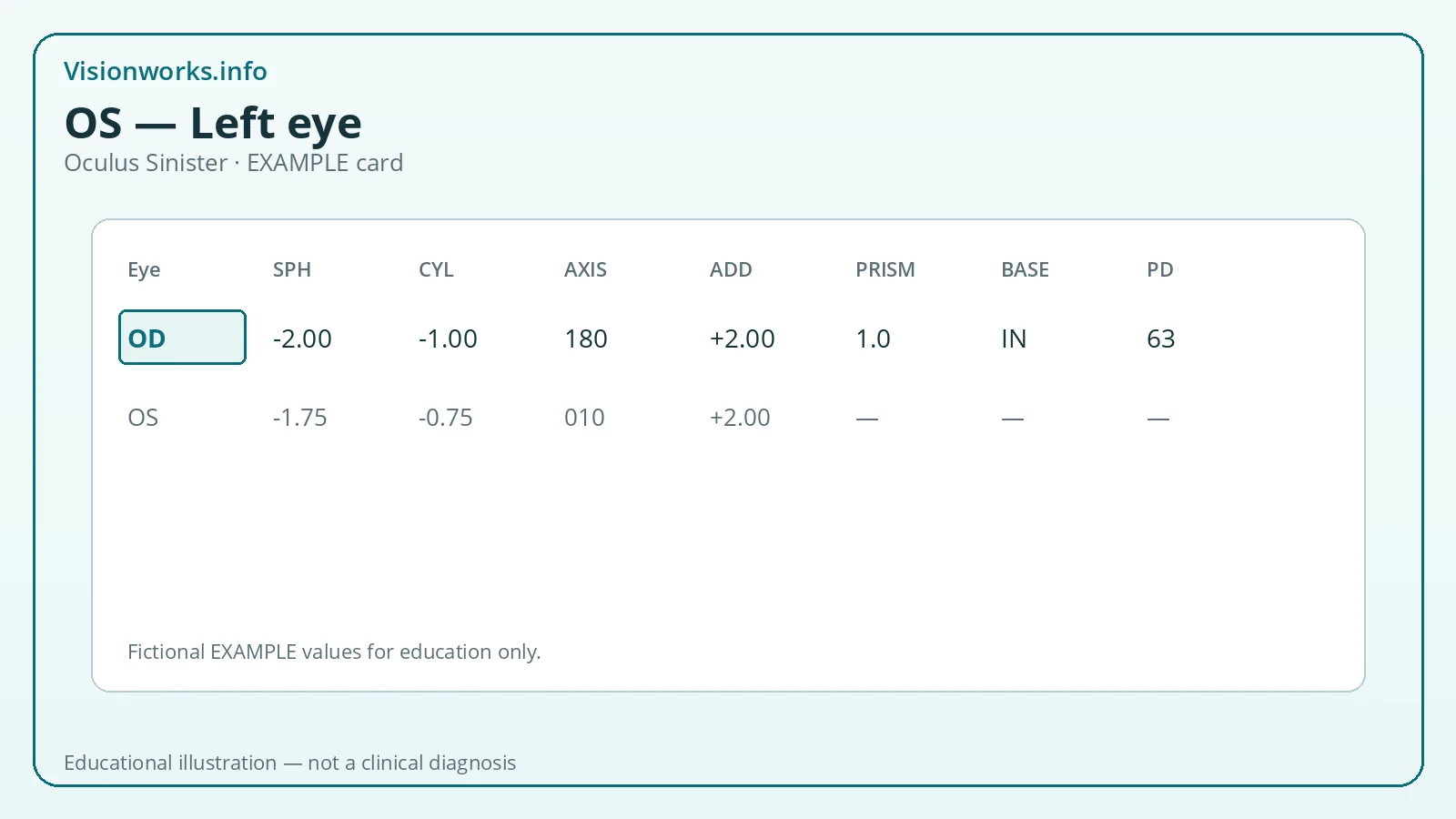
OS stands for oculus sinister and marks optical values for the left eye. It is the partner label to OD (right eye) on spectacle prescriptions. (Context page: /prescription/os/).
Mix-ups between OS and OD when reordering online are a frequent source of inverted lenses—especially when axis differs. Slow down and match labels, not just numbers you memorize as “the stronger eye.”
Left-eye values deserve the same careful reading as right-eye values even if one eye feels dominant.
How OS is written and read
On stacked forms, OS is commonly below OD. On side-by-side forms, OS may sit in the right-hand power block—verify headers every time. (Context page: /prescription/os/).
Some international documents use LE language instead of OS. If both appear across years of records, translate carefully rather than assuming a change in your left eye.
Handwritten OS axis values are easy to misread (for example 180 vs 110). Confirm ambiguous digits with the issuing office.
Left-eye specifics people overlook
Dominant-eye feelings do not always match which eye has the stronger sphere. Do not reorder based on dominance folklore alone. (Context page: /prescription/os/).
Monocular PD for the left eye matters for progressives and higher powers; a single binocular PD may be insufficient for some lens types.
Left-eye prism base direction is independent of the right eye’s base. “Mirror” the prism only if the written Rx says so.
OS in binocular context
Clinicians care how OS and OD work together for fusion and comfort. An OS power that looks fine in isolation can still need binocular adjustment. (Context page: /prescription/os/).
If you close the right eye and the world softens more than expected, that symptom is a reason for examination—not a DIY OS rewrite.
Amblyopia history often attaches to one eye; if OS is the historically weaker eye, best-corrected acuity may not match the fellow eye even with accurate glasses.
Common OS misconceptions
Misconception: “OS means over-the-counter strength.” It means left eye on the Rx grid. (Context page: /prescription/os/).
Misconception: “I can leave OS blank if that eye feels fine.” Incomplete forms cannot be fabricated safely.
Misconception: “OS diopters equal left-eye Snellen acuity.” Measure acuity separately.
Misconception: “Copying a friend’s OS numbers is close enough.” It is not.
OS versus visual acuity
Left-eye diopters do not map to a guaranteed left-eye 20/xx line for an individual. (Context page: /prescription/os/).
Clinics often record OS acuity unaided and aided; ask for those numbers if you are trying to understand function, not only power.
Binocular acuity can look better than OS alone, which is why monocular testing still matters.
Ordering and verification checklist for OS
Read the OS row aloud: sphere, cylinder, axis, add, prism/base if present. (Context page: /prescription/os/).
Confirm plus versus minus cylinder convention so OS sphere is not mis-transposed by accident.
Keep the clinic phone number handy when a portal PDF crops the OS axis column.
Left-eye scenarios that confuse buyers
OS plano sphere with −1.50 cylinder still needs an accurate axis—calling that eye “plano” in conversation erases the astigmatism correction. (Context page: /prescription/os/).
A left-eye ADD shared with OD can coexist with very different distance spheres; shared near addition is not shared distance power.
If OS acuity is reduced best-corrected while OD is not, that asymmetry is a clinical conversation—not something to “balance” by inventing OS power.
Preventing OS/OD swaps
Highlight the OS row in a contrasting color on your personal copy before uploading to sellers. (Context page: /prescription/os/).
Read numbers aloud as “left eye…” when phone-ordering with a partner helping.
Reject any workflow that asks for a single eye’s values when your Rx clearly lists two different eyes.
Putting this page to work
Learners reading /prescription/os/ usually want clarity without being upsold fear. This section adds practical literacy without inventing a personal diagnosis.
For /prescription/os/, keep three folders in mind: what the notation means, what it does not mean (especially Snellen conversion myths), and when to escalate from curiosity to a real appointment.
If you reached /prescription/os/ from a search about sudden symptoms—vision loss, curtains, flashes with many floaters, severe pain, chemicals, or trauma—prioritize urgent clinical triage over finishing an educational article.
If your interest in /prescription/os/ is gradual blur, overdue glasses, or paperwork confusion, plan a comprehensive exam and bring prior glasses plus printouts so comparisons are fair.
Visionworks.info remains independent educational media for pages like /prescription/os/: not a clinic, not a retailer, and not affiliated with Visionworks stores or VSP Vision.
State driving rules can come up beside topics like /prescription/os/; they vary and this site does not provide legal clearance or disqualification.
When professional care matters
If OS digits are blurry on a photo of your Rx, request a clean copy before ordering rather than guessing the left-eye axis.
Urgent or emergency evaluation is appropriate for sudden vision loss, a curtain or shadow over part of vision, new flashes with many floaters, severe eye pain, chemical splash, or trauma. Stable long-standing questions about /prescription/os/ usually belong in planned appointments—while rapid new change still deserves prompt triage.