
Answer first: what OD means
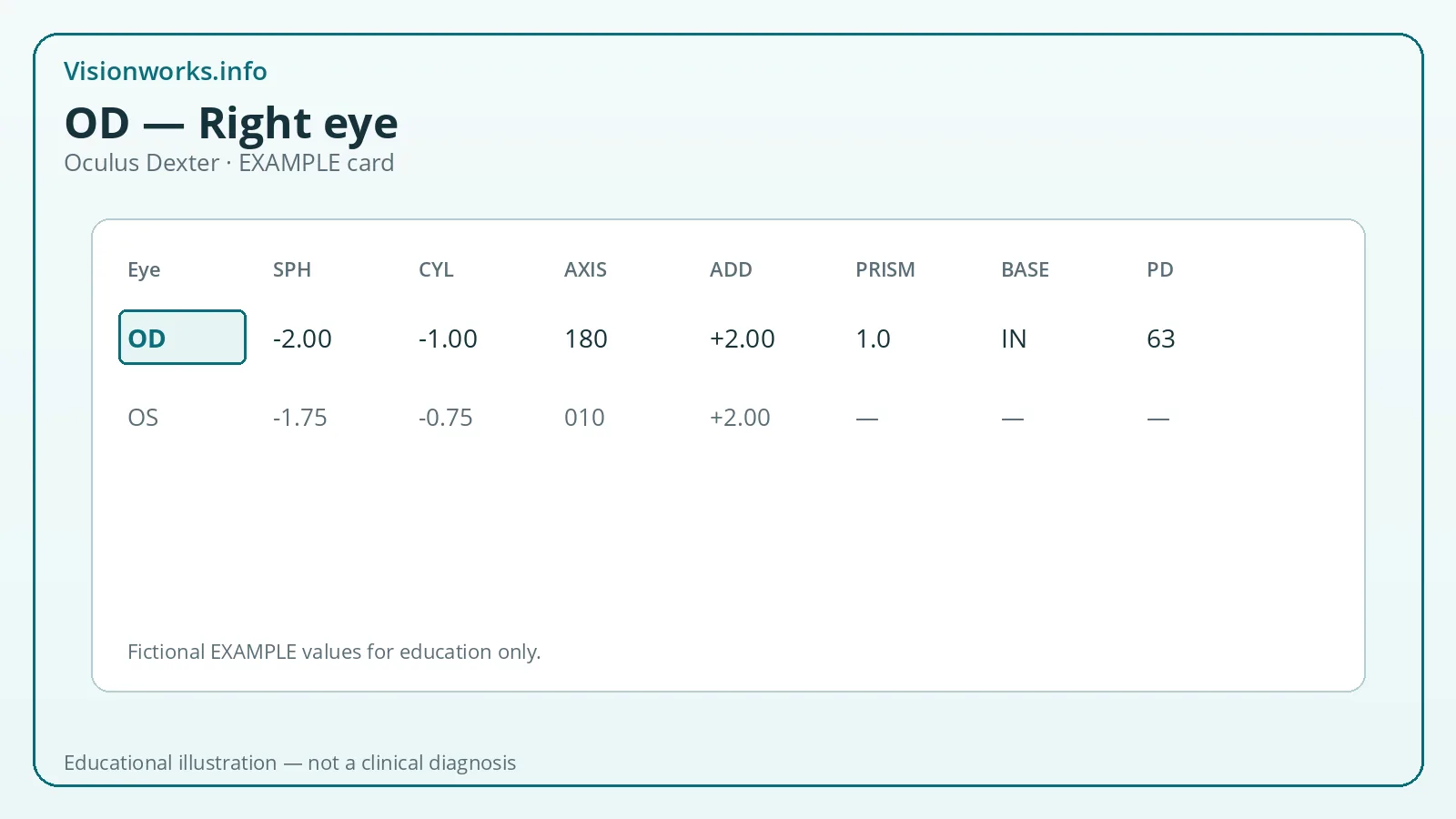
OD stands for oculus dexter and labels values for your right eye. On most spectacle prescriptions, OD appears as its own row or column beside OS (left eye). (Context page: /prescription/od/).
Everything printed on the OD line—sphere, cylinder, axis, add, prism—is an instruction set for fabricating the right lens and for clinical records, not a public score of how “good” that eye is.
If you only memorize “the stronger eye” without checking the OD header, you can invert lenses when reordering.
How OD appears on real forms
Some printouts stack OD above OS; others use a table with OD/OS on the left and power columns across the top. Electronic portals may abbreviate further. (Context page: /prescription/od/).
Handheld copies can be faint or cropped. If a digit is unreadable—especially axis—call the issuing office rather than guessing a right-eye axis from memory.
OU (both eyes) notes sometimes appear elsewhere on the form; they do not erase the need to read OD carefully when powers differ.
International records may say RE instead of OD; translate labels before assuming your right-eye powers changed.
Why OD and OS often differ
Anisometropia—different refractive needs between eyes—is common. A stronger OD sphere than OS is not automatically pathology; it is a reason to ensure binocular comfort was considered. (Context page: /prescription/od/).
Astigmatism axis can differ substantially between eyes. Copying OD axis onto OS when ordering is a classic DIY error.
Amblyopia or eye-health conditions can create asymmetric acuity even when OD and OS powers look similar—numbers are not the whole right-eye story.
Reading OD with the rest of the Rx
Sphere without cylinder/axis context is incomplete when CYL is present. Axis without CYL is incomplete. ADD may apply to near zones for both eyes or be specified per eye depending on the form. (Context page: /prescription/od/).
Prism on OD needs a base direction (in/out/up/down or combinations). Amount without base is not actionable for the right lens.
PD may be binocular or split into right/left monocular values used at dispensing; it may live on a separate optical measurement rather than the medical Rx pad.
Common OD misconceptions
Misconception: “OD means doctor of optometry on this line.” In prescription tables, OD is the right eye. Credentials are a different use of letters outside the power grid. (Context page: /prescription/od/).
Misconception: “The worse-looking OD number means that eye is diseased.” Magnitude ≠ diagnosis.
Misconception: “I can order contacts using OD glasses values alone.” Contact lenses need a contact lens prescription.
Misconception: “OD diopters equal a guaranteed right-eye 20/xx.” Acuity is measured separately.
OD values versus visual acuity
Diopters on the OD line do not convert into a guaranteed right-eye Snellen fraction. Clinics measure right-eye acuity separately—often uncorrected and corrected. (Context page: /prescription/od/).
A comfortable OD refraction can still coexist with reduced acuity if eye health limits resolution. Conversely, strong OD powers can yield excellent corrected acuity.
Ask for monocular acuity when the OD power looks “high” but your binocular world feels fine—or the reverse.
Practical tips before you reorder lenses
Match name, issue date, and expiration practices required by your seller and jurisdiction. (Context page: /prescription/od/).
Confirm whether cylinder notation is plus or minus cylinder so OD sphere is interpreted in the intended convention.
If OD changed a lot between visits, ask about transposition, measurement variability, or true refractive change before assuming sudden disease from paperwork alone.
Right-eye examples learners misread
A right-eye sphere of −2.00 with cylinder −1.00 axis 90 is a completely different lens than −2.00 sphere alone—even though people casually say “my right eye is a two.” (Context page: /prescription/od/).
If OD prism is 1Δ base out, reversing to base in is not a cosmetic tweak; it reverses the optical intent.
Monocular right PD used for a progressive cannot be replaced by guessing “half of binocular PD” when facial asymmetry is meaningful.
Documentation habits that protect OD accuracy
Store a PDF and a paper copy; portals sometimes truncate columns on mobile screenshots. (Context page: /prescription/od/).
When traveling, keep the clinic’s refill policy in mind rather than relying on an old OD line saved in notes app plain text.
If a seller’s form lacks an OD axis field but your Rx has cylinder, stop and fix the form mapping before paying.
Putting this page to work
Learners reading /prescription/od/ usually want clarity without being upsold fear. This section adds practical literacy without inventing a personal diagnosis.
For /prescription/od/, keep three folders in mind: what the notation means, what it does not mean (especially Snellen conversion myths), and when to escalate from curiosity to a real appointment.
If you reached /prescription/od/ from a search about sudden symptoms—vision loss, curtains, flashes with many floaters, severe pain, chemicals, or trauma—prioritize urgent clinical triage over finishing an educational article.
If your interest in /prescription/od/ is gradual blur, overdue glasses, or paperwork confusion, plan a comprehensive exam and bring prior glasses plus printouts so comparisons are fair.
Visionworks.info remains independent educational media for pages like /prescription/od/: not a clinic, not a retailer, and not affiliated with Visionworks stores or VSP Vision.
State driving rules can come up beside topics like /prescription/od/; they vary and this site does not provide legal clearance or disqualification.
When professional care matters
Bring both paper and portal copies if digits disagree; ask the clinic to clarify the OD line before you authorize fabrication.
Urgent or emergency evaluation is appropriate for sudden vision loss, a curtain or shadow over part of vision, new flashes with many floaters, severe eye pain, chemical splash, or trauma. Stable long-standing questions about /prescription/od/ usually belong in planned appointments—while rapid new change still deserves prompt triage.