
Answer first
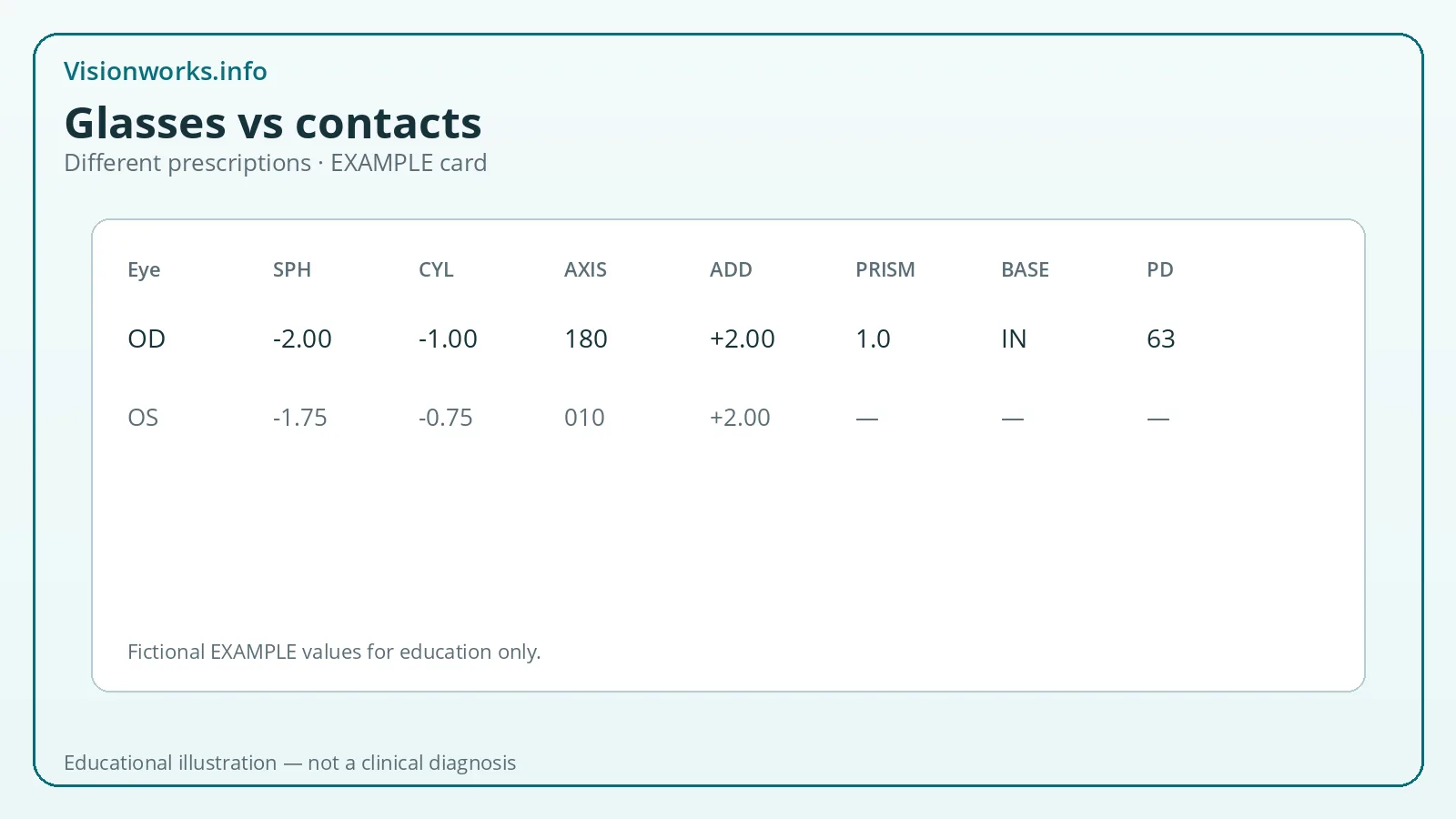
A glasses prescription and a contact lens prescription are related but not interchangeable documents. Contact lenses sit on the eye, so power, curvature, diameter, material, and replacement schedule become part of a valid Rx. (Context page: /prescription/glasses-vs-contacts/).
Copying glasses sphere/cylinder onto a contact order skips fitting and safety steps that exist for a reason.
In the U.S., contact lenses are regulated medical devices; buying them without a valid Rx undermines safety frameworks designed to protect eyes.
Why powers can differ
Vertex distance—the space from glasses lens to eye—matters more as power increases. Contact lenses at the corneal surface can require different powers than spectacles for the same person. (Context page: /prescription/glasses-vs-contacts/).
Astigmatism may be handled with toric soft lenses, rigid lenses, or other designs that do not match spectacle cylinder notation one-to-one.
Multifocal contact strategies differ from spectacle ADD designs; do not assume the same near number transfers.
Parameters glasses Rxs do not include
Base curve, diameter, material/brand, and replacement schedule are contact-specific. (Context page: /prescription/glasses-vs-contacts/).
Trial lens evaluation looks at movement, centration, and ocular surface response—not just a letter chart.
Follow-up timing after a new fit is part of responsible care, not optional paperwork.
Legal and safety education (not legal advice)
U.S. consumers can learn about contact lens prescription release and purchase rules via FTC and FDA educational materials linked in our sources. (Context page: /prescription/glasses-vs-contacts/).
Those rules do not replace an in-person evaluation when indicated, and this page is not legal counsel.
Cosmetic plano contacts still carry risk and still need legitimate pathways— “zero power” is not “zero responsibility.”
Acuity myths across formats
Clear acuity in glasses does not guarantee the same comfort or clarity in an unfitted contact. (Context page: /prescription/glasses-vs-contacts/).
Clear acuity in contacts does not mean you can abandon spectacle backups when advised to keep them.
Neither format’s diopters convert into a guaranteed personal Snellen line without measurement.
When people get into trouble
Using old glasses numbers to buy contacts after expiration. (Context page: /prescription/glasses-vs-contacts/).
Sharing lenses or sleeping in lenses against instructions.
Ignoring redness/pain because “vision still looks fine.” Comfort and health can diverge from acuity.
Practical takeaways
Keep separate copies of glasses and contact prescriptions. (Context page: /prescription/glasses-vs-contacts/).
Ask your clinician which tasks each correction is optimized for.
Use Visionworks.info to learn vocabulary—not to bypass fitting.
Extra consumer pitfalls
Expired prescriptions create gray areas that sellers and regulators treat seriously—ask the issuing office about renewal rather than editing dates. (Context page: /prescription/glasses-vs-contacts/).
Screenshots that cut off expiration or doctor information can delay legitimate fulfillment [glasses-vs-contacts].
Educational blogs cannot mediate a billing or release dispute with your clinic [glasses-vs-contacts].
Keeping records organized
Separate folders for glasses vs contacts prevent accidental cross-ordering. (Context page: /prescription/glasses-vs-contacts/).
Note the exam date beside each PDF filename [glasses-vs-contacts].
When numbers look impossible, verify with the clinic before assuming the portal glitched and self-editing [glasses-vs-contacts].
Putting this page to work
Learners reading /prescription/glasses-vs-contacts/ usually want clarity without being upsold fear. This section adds practical literacy without inventing a personal diagnosis.
For /prescription/glasses-vs-contacts/, keep three folders in mind: what the notation means, what it does not mean (especially Snellen conversion myths), and when to escalate from curiosity to a real appointment.
If you reached /prescription/glasses-vs-contacts/ from a search about sudden symptoms—vision loss, curtains, flashes with many floaters, severe pain, chemicals, or trauma—prioritize urgent clinical triage over finishing an educational article.
If your interest in /prescription/glasses-vs-contacts/ is gradual blur, overdue glasses, or paperwork confusion, plan a comprehensive exam and bring prior glasses plus printouts so comparisons are fair.
Visionworks.info remains independent educational media for pages like /prescription/glasses-vs-contacts/: not a clinic, not a retailer, and not affiliated with Visionworks stores or VSP Vision.
State driving rules can come up beside topics like /prescription/glasses-vs-contacts/; they vary and this site does not provide legal clearance or disqualification.
When professional care matters
Schedule a comprehensive eye exam if questions about glasses versus contact prescriptions coincide with new blur, headaches tied to visual tasks, night-driving difficulty, or overdue care. Online education cannot replace clinical refraction or eye-health evaluation.
Urgent or emergency evaluation is appropriate for sudden vision loss, a curtain or shadow over part of vision, new flashes with many floaters, severe eye pain, chemical splash, or trauma. Stable long-standing questions about /prescription/glasses-vs-contacts/ usually belong in planned appointments—while rapid new change still deserves prompt triage.