
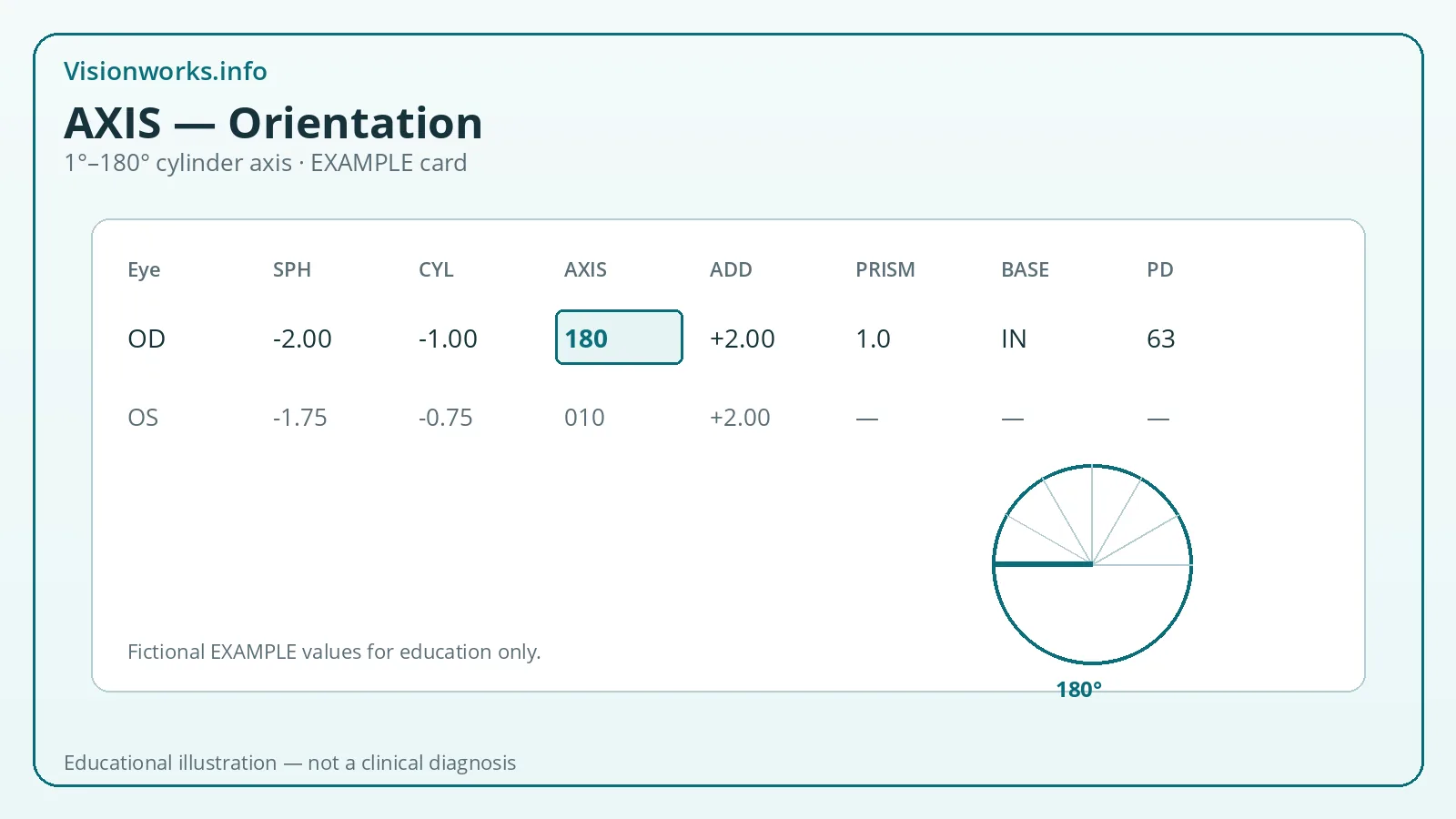
Answer first: what this field means
On a glasses prescription, AXIS refers to orientation in degrees for cylindrical power. (Context page: /prescription/axis/).
Axis values use degrees from 1 to 180 (or 0/180 depending on convention). Axis without cylinder is meaningless; cylinder without a usable axis is incomplete.
Axis is a direction, not a “strength.” A change from 10° to 170° can be a small angular shift near the horizontal, not a catastrophe by default—context matters.
Transposition between plus and minus cylinder changes written axis by about 90° while describing related optics—another reason to ask before panicking.
Understanding axis helps you ask better questions during dispensing and follow-up visits—not to self-prescribe.
How clinicians use AXIS
Eye-care professionals combine refraction results, binocular testing when indicated, and your visual tasks before writing AXIS. (Context page: /prescription/axis/).
The written axis field is an instruction for fabricating spectacles—not a standalone diagnosis label for public self-interpretation.
If AXIS looks different from a previous Rx, ask whether notation convention (plus vs minus cylinder), measurement variability, or a true change is involved.
Task-specific prescriptions (for example, computer distances) may adjust how axis appears relative to your everyday glasses.
Common misconceptions
“High axis numbers mean worse astigmatism.” Axis is orientation, not magnitude.
“Axis equals prism base.” Different concepts.
“Axis converts to acuity.” It does not.
Misconception: “I can order contacts from glasses AXIS alone.” Contact lenses require a valid contact lens prescription and fitting.
AXIS versus visual acuity
Diopters related to axis describe lens power. Visual acuity describes how small a detail you can resolve under test conditions.
They interact in populations but do not map one-to-one across people, lighting, or eye-health states [axis].
Visionworks.info will not convert your AXIS into a guaranteed 20/xx line.
Reading the field with its neighbors
AXIS rarely stands alone. Sphere, cylinder, axis, add, prism/base, and PD each answer different fabrication questions.
Illegible handwriting on one neighbor field can ruin an otherwise correct number—request a clean copy [axis].
Plus/minus cylinder transposition can reshuffle several fields at once; ask for the convention used [axis].
Practical ordering tips
Match patient name, issue date, and the exact AXIS value before authorizing lenses. (Context page: /prescription/axis/).
U.S. prescription-release education concerns access to your Rx copy; it is not a DIY refraction method [axis].
If an online form rejects your notation, contact the issuing clinic rather than inventing a workaround value [axis].
What this page will not do
This explainer will not prescribe a new AXIS for you or diagnose eye disease from a photo of paperwork. (Context page: /prescription/axis/).
Sudden vision loss, curtains, flashes with many floaters, severe pain, chemicals, or trauma need urgent clinical pathways—not field-definition reading [axis].
Gradual blur or curiosity about notation still deserves a planned exam when lenses or symptoms are involved [axis].
More context for learners of axis
People often find the axis field after a confusing online order form. Slowing down to match labels beats rushing into a wrong lens.
If your previous glasses feel fine but the new paperwork’s axis looks unfamiliar, compare conventions and bring both pairs to the visit.
Teach family helpers to photograph the entire Rx grid, not only the axis cell, so neighboring fields remain visible.
Comfort, adaptation, and expectations
New optics can feel swimmy for a short adaptation period; persistent nausea, diplopia, or marked blur deserves a call back to the clinic or dispenser. (Context page: /prescription/axis/).
Lighting, screen distance, and occupational demands influence whether a theoretically correct field feels comfortable all day [axis].
Do not stack multiple unverified changes (new PD + new CYL + new progressive) without professional guidance when troubleshooting discomfort [axis].
Putting this page to work
Learners reading /prescription/axis/ usually want clarity without being upsold fear. This section adds practical literacy without inventing a personal diagnosis.
For /prescription/axis/, keep three folders in mind: what the notation means, what it does not mean (especially Snellen conversion myths), and when to escalate from curiosity to a real appointment.
If you reached /prescription/axis/ from a search about sudden symptoms—vision loss, curtains, flashes with many floaters, severe pain, chemicals, or trauma—prioritize urgent clinical triage over finishing an educational article.
If your interest in /prescription/axis/ is gradual blur, overdue glasses, or paperwork confusion, plan a comprehensive exam and bring prior glasses plus printouts so comparisons are fair.
Visionworks.info remains independent educational media for pages like /prescription/axis/: not a clinic, not a retailer, and not affiliated with Visionworks stores or VSP Vision.
State driving rules can come up beside topics like /prescription/axis/; they vary and this site does not provide legal clearance or disqualification.
When professional care matters
Schedule a comprehensive eye exam if questions about axis coincide with new blur, headaches tied to visual tasks, night-driving difficulty, or overdue care. Online education cannot replace clinical refraction or eye-health evaluation.
Urgent or emergency evaluation is appropriate for sudden vision loss, a curtain or shadow over part of vision, new flashes with many floaters, severe eye pain, chemical splash, or trauma. Stable long-standing questions about /prescription/axis/ usually belong in planned appointments—while rapid new change still deserves prompt triage.